Tuesday, June 27, 2006

William Wegman Early Videos


Instead of discovering new trends in performative styles on YouTube, I seem to get attracted by the old avantgarde (why does this expression sound so nice?). And so, instead of a shaky home video of a new, unknown artist, here is a shaky video for all those that, like me, enjoy the snobism of exploring once explored territory. William Wegman became really famous not because he was good, but because his dog, Man Ray, was good. And Wegman had the good idea of showing him. And giving him the concepts any good curator provides an artist with. Wegman, of course, made (and continues to do so) a significant amount of other interesting semi-conceptual work (if we can have semi-conductors, can't we have semi-conceptualists?). But a significant part of it shows he knows his A-Bs in market-related works. Publicity is one of his main focuses. Ironic, indeed - and as we know, irony acknowledges its subject's presence and importance. And isn't using trademarking a dog just a brilliant move? I mean this honestly, with just a tiny little bit of irony.
See the first of the videos: choreography, drama, manipulation, humanity, self-consciousness (or lack thereof), individuality, contact, hidden agendas, thought. All this can clearly be found in here. It could pretty much be considered a contemporary piece. Some qualities make it dated. Which is interesting - since we accept it just as well, and enjoy it, and find it quite appealing and strong. So what makes it old? What is it about 70's conceptual art that makes it at once incredibly up-to-date and plainly dated? On one hand, many conceptual works are now being brought back to the scene. On the other, this repositioning has a certain distance that gives it the...space (?) we seem to require.

Wegman also has a (even) lighter side to him: these videos are sometimes closer to what we know as Saturday Night Live humor than to what we think of as video art. Man Ray rocks once again...

via

Saturday, June 24, 2006

Anne Wenzel: the reference game

I just can't stop thinking of references when I look at Anne Wenzel's work. Is this proof of lack of originality, or of a feel for Zeitgeist, or of knowing how to play with what she sees? Or is it just an obsession of mine...?

Functional Confusions remind me of a work I saw once in Paris (was it by Jeff Koons?) - a pillow made of glass. And of surrealist games.

Here> Arcimbolodo, Dali from the Slave Market... (this is a landscape from sauerkraut and saussage combined with a plastic reindeer)

Yves Klein, as well as some contemporary Japanese art, very happy-like, and a slightly punkish Sarah Lucas kind of thing (also Paul McCarthy - this is butter cream...)
Oh, and notice the dimensions of the last two works : the deer installation is 41cm x 23cm, and this last one is also a model of an exhibition. I find it gives the work a specific lightness that a 1:1 scale wouldn't necessarily have.


And this? Any ideas?

Saturday, June 17, 2006

Tim Crouch - "An Oak Tree"


If you want to know what Tim Crouch's An Oak Tree is about, and what it is like, first read his own description. You can also read the great reviews, although it might not be necessary after the first text. If you want to go deeper, there is a work called An Oak Tree, by Michael Craig-Martin, which inspired the piece. Now, join me.

This is not about hypnotism. Contrary to what Tim Crouch suggested after the show, I don't think a spectator is ever in a state of semi-hypnosis.
And this is not about hypnotism anyway. Although it might seem so - since it's all about the idea of believing in a world that isn't real. For the spectators, this means that we need to imagine most of the story. We get little fragments, bits and pieces, interpreted in a very "minimalist" way. The rest is our job. And that's fine, since we get lots of hints and aides in this imaginative work.
On the other hand, for the invited actor (every night a new one, and who doesn't know anything about the show) who simply follows instructions, believing in a world that isn't real means being manipulated. Doing things just because you are told to do so. How will you deal with it? And who are you when doing them? Are you the person that's trying to obey, are you some sort of an instant character, or are you yourself that decides to be someone else?
All this appears on stage in Tim Crouch's new piece. It is a true gem, a balanced, daring performance that left me fascinated by the mechanisms of belief and obedience. The story is a sad one, one of those tragedies that bring about the relief of melancholy. But we know it's just a story. We are being reminded time and again that this is all fake. Jumping in and out of the role, and insisting that the second actor not interpret (he simply doesn't get a chance to really go for it), Tim Crouch makes sure this doesn't become a psychological drama. One could even think the drama is taken away through all these theater and manipulative tricks and halts. But exactly the opposite happens: because it's so apparently dry and distant, we have breathing space. And we are forced to make the distance and imagine it all ourselves. Can you be any more distanced than having actors not act? Actually, you can, and Tim Crouch was - in his first play for adults, My Arm (before that he only made theater for children). And I think he went too far. In My Arm, the different roles were played by objects brought by the spectators. And since they were randomly chosen, they really had nothing to tell us. And it made little difference if we were watching, or just listening - the objects were sadly disposable. This time, though, everything changes. For suddenly, Tim Crouch, the master of objectification, has a challenge: a human being. And this human being on stage looks incredibly powerful and attractive because of the very fact of being one of us. And no matter how submitted he becomes, his presence is never disposable. The game between obedience and liberty is very subtle (little to do with gameshow situations). It has to do with orders, with subordinating oneself for the sake of something that is beyond you. And this is a little disturbing. We feel that Tim Crouch is using the actor, that although he doesn't ridicule him, he could, and this very possibility is discomforting.

The first night I saw it, the invited actress (the gender of the actor is indifferent to the play) was Cathy Nadan from Forced Entertainment. It was an unbelievable show. And although Tim insisted that no show is better or worse because of the actor, that they are simply different, I had a different impression. The next day I went to see the show again, this time with Teatro Praga's André C. Teodosio. He is a very good actor and it went fine. But it also confirmed what I'd suspected: that previous night was something special. You see, you have a show where it's all about instant reactions - reading from a text, repeating what you are told, making the actions you are told to... and you have an actress that has been doing exactly this (well, not only) for some 20 years. Maybe that's why she simply didn't let him manipulate too much - she gained a very delicate, and yet powerful, autonomy. It looked as if the role had been written for her: the perfect amount of an "amateur" attitude, just the right touch of pure theater interpretation, and above all, going with the flow as if this were the most natural of all things that can possibly happen on stage. Because of that, the strange feeling that it's a one man show after all went away, leaving us with what one of the best things the stage can offer: a true performance, where people do things and react and make us wonder how come we never see anything that pretty.

Thursday, June 15, 2006

Pole

Marcin Maciejowski, Emmigrant, oil on canvas (2006)


found at this great Polish blog about art, where you can discover some excellent contemporary works by artists both Polish and foreign.

Tuesday, June 13, 2006

Night-Seeing

Here, have some Bill Henson.


If there were only darkness in the darkness, we would never look into it, would we?

Objective criticism

A judge is not allowed to take a case if he knows personally the one he judges. Shouldn't it be the same in art criticism?
But then, how would criticism be possible, if the critic is everybody's (quasi) friend? And, after all, social life is, many would say, crucial to the art world.
If this is the case, the reviewer should clearly state his relation to the reviewed (e.g., degree of intimacy, number of conversations in the last week, month, year, common friends, social events both attended, etc.). I mean this quite seriously. This would also allow the reviewer to write more objectively, without worrying about the pain of hurting the ones we care about (and whatever you say, a bad review can hurt). It would make things clear: everyone knows about us, so I simply can't promote you. I can advise you, help you, work with you. I can listen to your explanations (which is already a great advantage you have). But this is where it stops.
And if it doesn't, if you resist everything but the temptation to "help" your friends, at least things are a little clearer for the public that is not in.

Jerôme Bel by Pichet Klunchun by Jerôme Bel


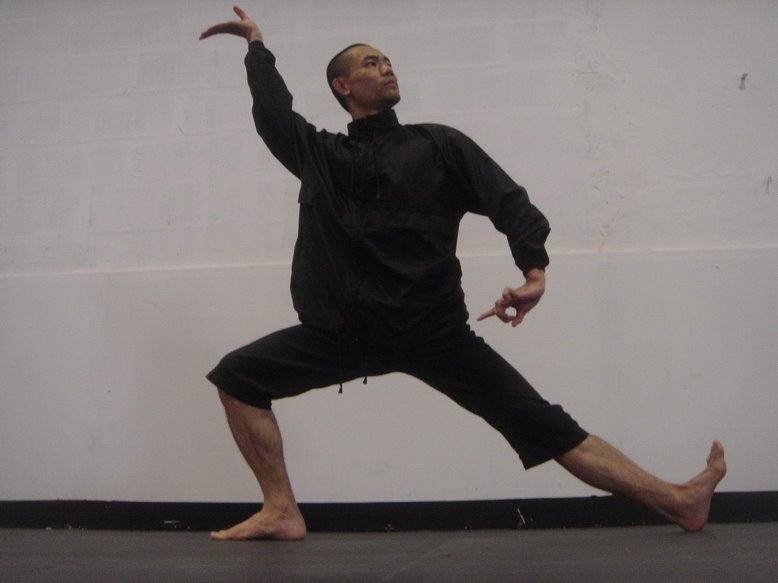
Pichet Klunchun and Myself, a performance directed by Jerôme Bel, at the Alkantara Festival in Lisbon

Is it really that simple? Dancer X meets dancer Y, asks dancer Y some questions, dancer Y demonstrates, than vice versa, dancer Y interrogates dancer X... and you have a show?
Almost.
Jerôme Bel, the master of entertaining conceptual performance (that some still call dance), seems to like simple formats: dance to (pop) music (The Show Must Go On), discover the body (Jérôme Bel), explain what you do (Isabel Torres). This time, the idea is of a meeting. Two people from different cultures, unknown to each other, meet. They sit down and ask each other questions about who they are and what they do and why they do what they do.
For some time, it might seem like a TV program. Pichet Klunchun, a Thai traditional dancer, tells his story and his art, he explains the basics of his work, and translates the complex vocabulary of Khon, an incredibly formal dance theater. Just a few elements distinguish this from a talk show: the attitude of Bel - respectful and purposefuly ignorant (the only element on stage besides two chairs is Bel's laptop), some very carefuly prepared answers and actions. Bel asks well. Almost as if by chance, the topic becomes death. Klunchun's incredibly slow and formal dance entry, showing one of the ways they represent death in Khon, is one of the shows most touching moments.
Another is the Thai's reaction to Bel's presentation of how he dies on stage. Because - you guessed it - the roles switch and now it is up to Bel to show the power of his art. Klunchun asks apparently innocent questions, Bel gives apparently silly answers. Klunchun is suprized, but accepts them and appreciates them. And somehow convinces us, through this strong, deep reaction, than there is more to Bel's provocative on-stage attitude (he openly admits he provokes the public, because they'll pay for the ticket anyway) than just provocation.
It is a beautiful meeting. There isn't a sign of interpretation, it all looks fresh and honest, nearly genuine. The show-and-tell format allows us to feel comfortable, as if the show went on and off, giving us plenty of room to think or just be comfortable. Of course, that is also the idea behind talk shows and circus: show a little, talk a little, don't make it too hard on the audience. But that is something I can live with. I much prefer this to actually trying to make it too hard on the audience which is so often the case. We are simple people, we see the show once, we don't know you and are unsure if we want to know you - don't scare us away too fast, please.
If there is something I found less convincing, it was the manipulative and somehow stereotypical way of seeing this meeting. Here is what I mean. Klunchun is Thai and dances a traditional Thai dance. But he says himself that he has lived in the West for many years and studied Western dance. And, although he claims he "didn't understand it", from his questions one could deduct he simply didn't understand a single thing, or lived isolated from the world. They are questions of a traditional Thai dancer, but I'm not sure such a dancer actually exists, let alone in that theater. It seemed more like Bel needed a somewhat naive, innocent character, asking the simple questions, so he could explain what he did. And that's a pity, because it would be quite fine if Klunchun simply admitted he will ask some questions from the traditional Thai point of view, as apparently he became interested in this perspective once again (in real life, that is).

Another question, which has been bothering me in several other performances, is the convention of "first time meeting". Why should we accept it, if we are to assume they are being honest? Isn't this cheating, as in, not admitting that you're not being genuine, you are reproducing something? But what alternatives are there?