Wednesday, April 26, 2006
Work
I have been working hard on a performance by Performaria, an academic group I'm directing. And also, in the free time, seeing films at the Indielisboa festival. I hope to bring more on all of the above soon.

Sunday, April 23, 2006
Christian Tedeschi


- says Christian Tedeschi. And it is true of his works: at first glance they seem scary, dangerous, aggressive. But once we look more carefully, we see a light-heartedness that enchants. For once, the heavy matter turns into crystal form. For once, Beuys is misundertood as he should be, without the huffing and puffing of someone too old to be a disciple. And so, the matter dances and plays. It swirls in the air as if it weren't suspended. It moves by itself. But don't be fooled - it does nothing of itself. Even if it takes 10 seconds to reorganize it, the world stands anew. Enthropy? Erosion? A gentle spin of time?
I believe in art that one trips over,
Tumbles blindly
Down several flights of stairs
To end up on their own two feet.
Virtually unscathed, and
Into the arms of their sweetheart.
Technorati:
Saturday, April 22, 2006
A Glimpse of Infinity?

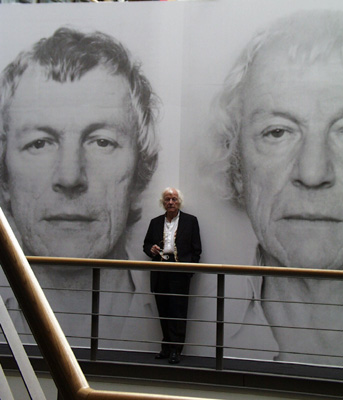
Camera Obscura 2005/1-Inf is a worldwide project in which two holes of a twin-holed pinhole camera are being auctioned simultaneously on Ebay every week. This project is dedicated to the polish artist Roman Opalka and his work 1965/1-∞. The highest bidders in each case receive one after the other a pinhole camera loaded with a piece of unexposed sheet of 5x7 Inch b/w film.There is a sense of global fraternity and timelessness in this project that's appealing. Opałka is a great reference to have - he is an artist I have come to appreciate and there is much to learn from him. One of the things is persistence. Another is discipline. Yet another, choosing the right format. If you get your format right, the work works with you, if not for you.
I'm not convinced that the authors, Przemek Zajfert and Burkhard Walther, figured out the format right. Not that it's bad - it works, and the kaleidoscope of scenes actually starts to develop. The actual photos must be immensely more interesting, with details we can barely figure out or imagine on the net (the quality of the posted pics could be better!). Still, that's just one part of the picture. Another is the question of, well, infinity. Of time. Or rhythm. Or a key of some sort. In this case, there is none. Time is gone, there is no development, and the pictures represent - whatever someone wants them to, plus the usual pinhole surprize. And that's a pity. One could easily imagine a slightly more disciplined version, with a "theme", or some rules that would create a more coherent whole. Otherwise the risk is getting simply too creative.
(Below - images of Opałka's work.)




Technorati:
Wednesday, April 19, 2006
Cattelan's perverted victory


Of course, it's not his fault. He simply made the art. And if someone interpreted it wrong, well, they interpreted it wrong.
As many of you know, in 2004 the Italian sculptor Maurizio Cattelan hung three plastic dolls of children from Milan's oldest tree.
Shortly after being officially "open", the exhibition came to a sudden end: Franco De Benedetto, a Milenese man, decided to cut the children off. He cut two ropes, but swayed and fell when cutting the third one. He was injured and taken to hospital.
Cattelan graciously didn't press charges, but the city of Milan did. And won. De Benedetto will be spending three months in prison for destroying a work of art. Mind you, it took them nearly two years to establish this was indeed a work of art, as that was the prosecution's main argument.
Some say he simply misinterpreted the nature of the work:
Maybe, as the ambulance blared through the Milan streets, di Benedetto was moved to reflect on the violent collision of two types of judgment: civic and aesthetic. He seemed to have mistaken one for the other; or rather, he’d disallowed the second as soon as he set out on his hapless clamber.I quite disagree. I think the whole work was based on the game between a work of art and a "natural" surrounding. As it is often the case with Cattelan, it was supposed to create uncertainty about the exact role of the work. Only here, it could easily bring uncertainty as to whether the sculptures were real or not.
In places where guns are illegal it is also a crime to pretend one has a gun. Even if you said it was a work of art, you would still be inciting a certain type of behaviour, suggesting a certain reality. I believe this is exactly the case here. This is not to say Cattelan is a criminal, case closed. Not at all. But since he plays in the real world, he should accept the real world's rules. And he does - by neither accusing De Benedetto formally, nor insisting on hanging the children again. But he creates a situation and then washes his hands, as if he wasn't its author. De Benedetto hurt himself and wound up in the hospital. This should be enough. The contact between art and reality is made quite explicit in this fall. The score seems so naturally set. Why go further?

Technorati:
Monday, April 17, 2006
3 pics of people by Ron Mueck

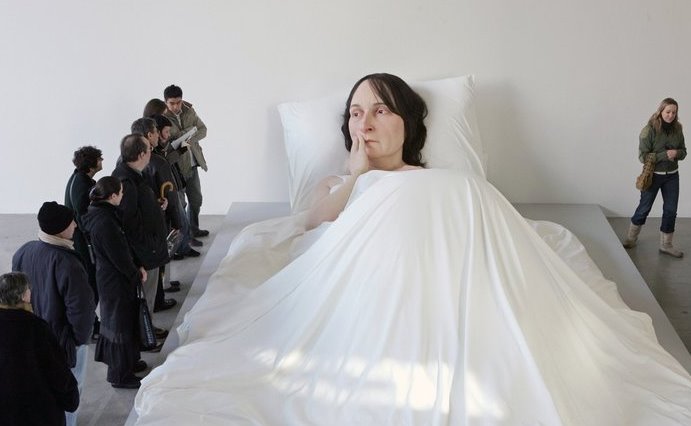
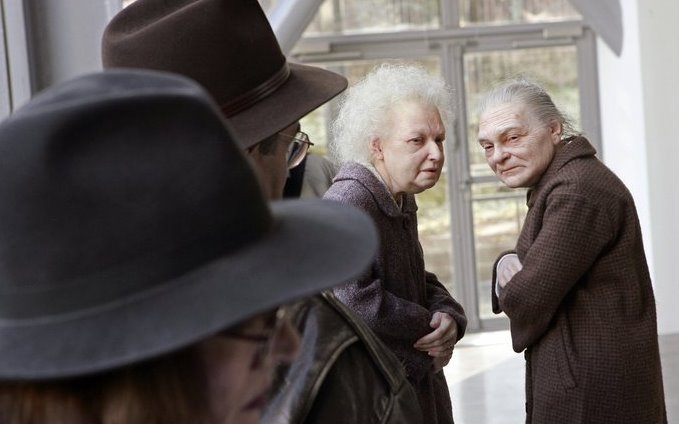 What I like in Ron Mueck's work is not so much the "life-likeness" of the figures (that has been done and re-done). It is their dramatic character, their theatricality. They have their stories, personalities, they are not types of people (like Duane Hanson's characters often were).
The pictures come from the Washington Post and have an added value: they create stories between the sculptures and the onlookers. This performative play, this superimposed dialogue, is a blessing - it takes our attention off the "look how real it looks" aspect and shows another level in the naturalistic technique.
Technorati:
Sunday, April 16, 2006
Writing down the dance
The history of contemporary dance knows many attempts at pinning down the choreographic composition. None of them is perfect though - and the main flaw is that they are mainly character-based, i.e., they create signs to represent movements. This semiotic approach has obvious limitations - the purity of movement, its dynamic and time is gone. Also, it takes a long time for someone to understand how a system works, so as to repeat it, or even read it correctly.
Simply recording on video also isn't enough, as it lacks all the advantages of symbolic transcription: yes, you can see what's happening, but how are you to explain it? How are you to know if what you're doing is the same? It all requires quite a lot of imagination, and one usually ends up confused and unable to really "get the real thing".
So how is a choreographer to mark down what he's come up with?
Here is a new, pretty solution:

ps: Following the comment that "this has been done before. done a lot":Yes, it has. Using software to work with choreography has an entire history, that goes back at least to the great Merce Cunningham's 1989 performance with the program Life Forms. There were - and are - many other choreographers and programmers that followed. I'm not specialist on the matter - read more about it here and here and here. (Some examples of software are Isadora, the Choreograph, the Chaographer and the Interactive Choreographic Sketchbook). However, what seems to me particularly appealing about the Rotosketch is a combination of factors: 1) the possibility of including time as one of the variables in the sketch; 2) the "photoshop" characterisics that make it easy and intuitive (just use the pen and pad...); 3) the availability of the software (free download on the net); 4) the possibility of playing between the level of choreography and drawing. As you can see on the video, the sketch is really an interpretation of the draughtsman/analyst, allowing for a more personal, less software-dependent approach.
(via)
Simply recording on video also isn't enough, as it lacks all the advantages of symbolic transcription: yes, you can see what's happening, but how are you to explain it? How are you to know if what you're doing is the same? It all requires quite a lot of imagination, and one usually ends up confused and unable to really "get the real thing".
So how is a choreographer to mark down what he's come up with?
Here is a new, pretty solution:
Rotosketch is an intuitive tool for sketching, doodling and notating on top of video, such that the marks that are made are linked in time with the video. This allows the user to draw strokes along the the axis of time, as well as the normal x and y axes, and for those strokes to augment, analyze, interpret, or even obliterate a video sequence.
ps: Following the comment that "this has been done before. done a lot":Yes, it has. Using software to work with choreography has an entire history, that goes back at least to the great Merce Cunningham's 1989 performance with the program Life Forms. There were - and are - many other choreographers and programmers that followed. I'm not specialist on the matter - read more about it here and here and here. (Some examples of software are Isadora, the Choreograph, the Chaographer and the Interactive Choreographic Sketchbook). However, what seems to me particularly appealing about the Rotosketch is a combination of factors: 1) the possibility of including time as one of the variables in the sketch; 2) the "photoshop" characterisics that make it easy and intuitive (just use the pen and pad...); 3) the availability of the software (free download on the net); 4) the possibility of playing between the level of choreography and drawing. As you can see on the video, the sketch is really an interpretation of the draughtsman/analyst, allowing for a more personal, less software-dependent approach.
(via)
Technorati:
Saturday, April 15, 2006


Subscribe to:
Posts (Atom)