A recent work by Banksy, around L.A.
Technorati:
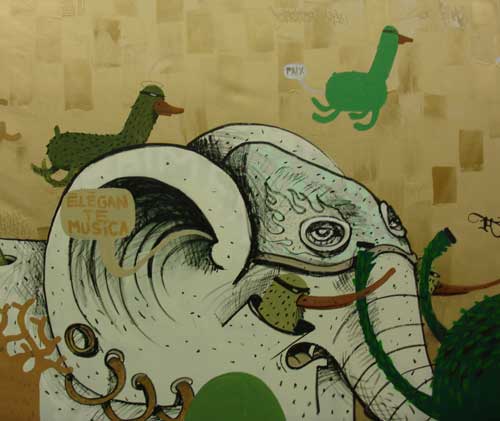
 Before I post something more extensive about the "recent" grungy, stencilated and mashed-up aesthetics in fine arts, let me introduce you to the Goldmine Shithouse collective. They started off as a fairly loose group of artist friends, who would meet once a week to stir things up, which they then proceed to do. One of them would start a painting, and then pass it on to others. Each work was a chain creation. Out of this group, three people remained: David Hochbaum, Travis Lindquist and Colin Burns. They liked the way it worked for them so much, they started exhibiting their works. It worked. And it is still working three years later.
- asks Don Foster in a recent article in N.Y.Times.
May not a Pollock forgery that passes for authentic be the best Pollock of all?
LAST year, 24 paintings were unveiled as previously unknown works by Jackson Pollock. (...)
But Richard Taylor, a physics professor retained by the Pollock-Krasner Foundation to subject six of the paintings to computer-assisted analysis, discovered that the paintings may well be fakes — at least, the drips lack Pollock's characteristic geometric pattern. The collection's owner disputes that this finding is conclusive.
At the heart of the controversy lie critical questions about artistic meaning and value that have vexed literary scholars no less than art historians. Would the exposure of a hitherto successful forgery diminish Jackson Pollock's reputation as a unique creative genius, by demonstrating that his work is replicable? If Shakespeare were credited with a mediocre poem hitherto presumed to be written by a lesser light, would that change our opinion of Shakespeare?
"What matter who's speaking?" asked Michel Foucault, quoting Samuel Beckett.
What matter whose painting? The implied answer — no matter at all — takes for granted that cultural artifacts are symptomatic of the society that produced them. The critic's job, then, is to assess the product on its own merits, quite apart from the artist's name or reputation. If "Hamlet" had been written by Christopher Marlowe or Edward de Vere, not by William Shakespeare, would the text therefore be less great? Perhaps not, but we would think of it in a different way.
If a previously authenticated Pollock painting was actually done by a disciple, or by Norman Rockwell, or by a monkey with a paintball gun, yet looks to be authentic Pollock, so what? The look-alike might be worth less at Sotheby's, but would it be worth less as art?
At stake in such attributional debates is a question of methodology: how can experts tell the difference between the real thing and an imitation? If the qualitative judgment of Pollock or Shakespeare scholars differs from quantitative analysis of a computer-assisted study, whose verdict will carry the day? That Richard Taylor's analysis can inform us of patterns generated by Pollock much of the time provides no guarantee that Pollock reproduced those patterns all of the time. But if the Pollock canon includes a forgery, it may be that Taylor's analysis provides a more objective mode of analysis than aesthetic appreciation.
(...)
In the art world, the problem of attribution is complicated by market value.(...) if you have paid, say, a half-million for a Pollock painting and some physicist and his computer say that you were hoodwinked, the question of the work's value is not wholly aesthetic.Literary and art attribution is not just a game of pin the name on the donkey. A community of interested scholars must consider all available evidence, and come to a consensus. In the case of the Pollock canon, the jury is still out. It would be a mistake, in my opinion, to sell the disputed Pollock canvases at a discount without more evidence than computer-assisted analysis of drip patterns.
Meanwhile, Jackson Pollock may be chuckling in his grave: if the object of Abstract Expressionist work is to embody the rebellious, the anarchic, the highly idiosyncratic — if we embrace Pollock's work for its anti-figurative aesthetic — may faux-Pollock not be quintessential Pollock? May not a Pollock forgery that passes for authentic be the best Pollock of all?
 2) Reality check: artists aren't always right. Not even about their own work. Pollock might have dreamed of " the rebellious, the anarchic, the highly idiosyncratic", but he never moved beyond the canvas (he never even made the tiniest hole in it, as Fontana ever-so-modestly mentioned). Artists say a lot of things. And dream of even more. That's our job. If we don't dream, something is wrong. As Jules Verne put it, there are no great achievements without exaggerated expectations. But if this is true, we simply cannot take the artist's word for it. Or at least, we don't need to. Not even when they're dead and famous (what a scary combination!). That's why we might just pay more attention to our way of seeing The Fountain, or a drip painting, than to that of the artist. After all, if we listened to the wonderful, charming futurists, we wouldn't even know them.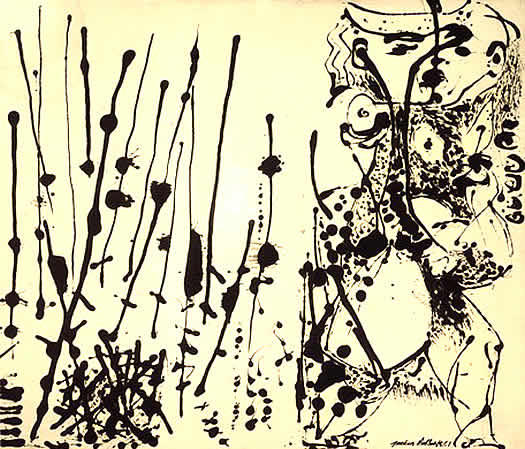
 (1984)
 (1998)
 (2006)