Saturday, November 25, 2006

Yinka Shonibare and the artist's freedom

Yinka Shonibare, Scramble for Africa (2003)

Shonibare's most famous works play on the idea of origin and power. The first lecture is clear: headless people are scrambling for Africa. They are dressed in European clothes, but made of African fabric. They are false. But this goes further. The type of cloth they use, called batik, is used throughout Africa (and not only) and considered a local tradition. But, as Shonibare says, that is not the case:
...the fabrics are not authentically African – they were produced by the Dutch in the 19th century and then subsequently by the English for sales to the African market.
That makes the situation even more absurd and scary. What is left of Africa? And what can be left for Africa?

But there is another issue related to Shonibare that has been interesting me more. The freedom of the artist vs. the necessity of his functioning well in the system.
Let's start off with this:

Yinka Shonibare, The Swing (after Fragonard) (2001)

How much does the artist need to know about what he is doing?
And really the idea behind it is to draw a parallel with the relationship between the contemporary first world and third-world countries. I want to show that behind excessive lifestyles there are people who have to provide the labour to make this kind of lifestyle happen.

But generally I think I made a piece of work about this painting because I actually admire the work very much. And I like the contradiction of taking something that’s supposedly ‘ethnic’ and putting that onto classical European painting.

All this seems fairly light, naive, compared to what the critics have to say about Yinka Shonibare's works. Does this mean he is unaware of the worlds he is creating? Is he simply using strong imagery that brings about a huge load of references? Possibly. Does that change anything? Does that make him a worse artist? Should the artist be his own critic? Should he be a philosopher as well?

Obviously, the artist part of being an artist is to make art. And then, see what happens. That's in the ideal world. In the one I know, the artist also sells his product, by being who he is, by having the life he has, by speaking the way he speaks. This doesn't signify the impossibility of defending oneself through work alone, but certainly makes it all the more difficult. And brings another issue.

What if Yinka Shonibare didn't make contemporary ethnic art? What if his work were just contemporary, and dealt with, say McDonald's or sex or any other issue? And let's imagine, for the sake of the argument, that it weren't any worse than what he is doing now. Would we know him? Who would he be? Would it matter that he is black, was born in London, lived in Nigeria and studied at Goldsmiths? There is a very irritating way the art world defines itself through basic associations of life and work. Possibly this has to do with the art having moved into a direction that is so difficult to judge (although artists like Shonibare play remixing the old school in a somewhat old-school way) that more is required in order to give it value (clearly also market value).

What happens to the freedom of the artist? What freedom does the artist have? Will we ever know of Shonibare's landscape sketches? And more broadly: how does an artist deal with the fact that many of his better ideas might not actually be better as seen from a social/market perspective, while some of his simpler, more obvious ideas are caught on and bought on the spot? How many more African-dressed figures does Shonibare need to make? How many can he handle? Isn't this exactly the same branding phenomenon as in other areas of commerce? Can we still call this investigation and digging in? How often do we see an artist still digging many, many exhibitions later, when he really shouldn't? I believe Louise Bourgeois said about Francis Bacon that it is true that he always paints the same painting, but it's a very beautiful painting.

Isn't there something wrong with this picture? Some sort of an obsession that has more to do with the way one is seen than with the way one sees? Of course, Bacon had enough guts to spill them over and over again on the canvas. But let's put it bluntly: most of us, most of artists, are not Francis Bacon. And still, they keep on painting the same painting. Looking for what? Perfection? Style? Truth? Exploring? Or self-branding, self-censoring?

Yinka Shonibare, Toy Painting 26 & Toy Painting 27 (2005)

Tuesday, November 21, 2006

Shadowing light. Jindřich Štreit.

This magnificent artist has been recommended to me by my brother. Just look:

And more...


I feel like showing most of the images on the site which represents him, www.talent.cz.
One thing makes me wonder. All of the pictures above were taken in Czechoslovakia before 1989. The question that comes to mind is: what can be the role of the circumstances on a photographer's quality? If a photographer is a document-maker (in a broad sense, and I mean a photographer that goes out of the studio), than doesn't the reality he has access to play a crucial role? How would he deal with a less unreal reality?
Jindřich Štreit tried. Many of the pictures were taken in France, some in Germany (?). And they do look more pale. Some of them are very pretty, some play with the idea of social criticism, but it seems far from the quality of the Czech works:
So is this a question of time? Does the world today have less to offer to the eye of a photographer? Apparently not:

The picture was taken in 1997. But in Siberia. Which still remains somewhat exotic. Exotic. There's the rub. Maybe the politician that bows while saying hello is just as exotic to someone from a different culture as many of those pictures are to us? (And then, of course, what is "us"? Isn't it an impossible word when publishing something on this site?)
So the question is: can the world be really becoming boring, or is it just becoming more alike to a certain standard we are used to, and this standard is just as ex-centric to someone from somewhere else as this someone is to us? And another, more specific point: what is the artists position in this mutating situation? Or rather, what are his possible positions? How does the role of a witness change in these changing times?

Saturday, November 18, 2006

Make art to experience and not art to read about

"7. Don’t make modern art.

Modern art tends to be ironical, cynical, self referential, afraid of beauty, afraid of meaning
-other than the trendy discourse of the day-,
afraid of technology, anti-artistry.
Furthermore contemporary art is a marginal niche.
The audience is elsewhere.
Go to them rather then expecting them to come to the museum.
Contemporary art is a style, a genre, a format.
Think!

Do not fear beauty.
Do not fear pleasure.

(...)


Real people are starving for meaningful experiences.
And what’s more:

society needs you.

Contemporary civilisations are declining at an unsurpassed rate.
Fundamentalism.
Fascism.
Populism.
War.
Pollution.
The world is collapsing while the Artists twiddle their thumbs in the museums.

Step into the world.
Into the private worlds of individuals.
Share your vision.

Connect.
Connect.
Communicate.

8. Reject conceptualism.

Make art for people,
not for documentation.
Make art to experience
and not to read about.
Use the language of your medium to communicate all there is to know.
The user should never be required to read a description or a manual.

Don’t parody things that are better than you.

(...)

Don’t settle yourself in the position of the underdog: surpass them!
Go over their heads!
Dominate them!
Show them how it’s done!

Put the artistry back in Art.
Reject conceptualism.
Make art for people, not for documentation.
Make art to experience and not art to read about. Use the language of your work to communicate its content. The audience should never be required to read the description.
The work should communicate all that is required to understand it. "

-
Realtime art manifesto (fragment)
by Auriea Harvey & Michaël Samyn

(but see e.g. the comment to this post at networkable social object for a critical view of the above)

Friday, November 17, 2006


Delicious.
The only thing that irritates me here - and I suppose that's just a silly problem - is that the brilliant guys that created this, Winkler and Noah, have absolutely no problem whatsoever selling these wonderful, environmentally friendly messages...

... and next to them, selling some of the most environmentally unfriendly ones. It's as if there was no difference. Who are they, you might say, to decide on that? They simply do their job, and that is, to come up with something that sells well whatever it is its supposed to sell. Hmmm... I guess you're right.
But just go beyond the surface of it's all the same and compare this to Adbusters. While Adbusters try to be the Good Guys (with all the risks that are part of it), Winkler and Noah would be an example of the UnGuys - neither good or bad. Excellent quality for sale. Sound right?

(via)

Thursday, November 16, 2006

The Perfect Gift


Keep the world full of surprises.
If you don't have any books to cross, and are really not in the mood for a birthday party performance, then think of something else. Make it fluffy, hard, shiny, matte, transparent, sticky, disgusting, funny, shocking, simple, personal, whatever you make it,
hide it.
Anywhere you want, as long as it's a place accessible to anyone.
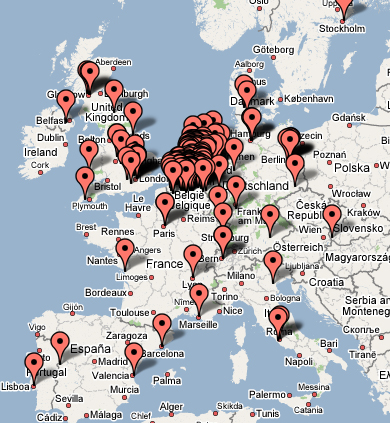
Then, go to Drop Spots, and put your drop spot on the map. So far, it seems to have been extremely popular around Belgium and the Netherlands. I suppose the authors - Brijetta Hall, Dan Phiffer and Ed Purver - might have something to do with it?
So far, there is only one drop spot in Lisbon. Hopefully this will quickly change. I'll try to participate as well.
(There isn't a single drop spot in Poland! Get to work, people!)

***

How far are we today from the first experiences with 'pervasive internet' by the folks from Blast Theory? Not very far. The gaming industry is getting all happy, there are new initiatives (especially with locative media, but not only - see this absolutely amazing site with pretty much everything you thought was possible already cataloged). But one can feel all this is still very young. Artists don't really know what to do of all these possibilities. It seems like the world is suddenly too large, not too small. And so these are small experiments for something that, I think, will be much more impressive, overwhelming, and deep-going than anything we see around today. Are you as curious as I am?

Tuesday, November 14, 2006

Layers

Of course, of course. This is not what it seems.
This is not a concrete column. This is not graffiti. This is something entirely different. It is a picture, a photo of graffiti. It is printed on dibond, the type of aluminum that is used for traffic signs, for example. And these metal sheets are then screwed onto a plywood construction. And all this is put in a different, non-street setting (in this case, the «lovely Dicken's Library of the Mary Ward House, Bloomsbury, London», but in another, more gallery-like setting, which make it seem much poorer, almost as if it were a strictly site-specific installation).
But what is striking about this is that it is exactly what it seems - a dislocated object, a rupture in reality, an addition that questions its context. In that sense, it is correct to say this is a column with graffiti. Because here, in this space, that is what works, what creates the tension. And then, all the other levels come into play, in this sort of a hide-and-seek of «objectiveness». It all stops somewhere, because it is a self-commenting (self-referential, if you like) convention. It plays on the very fact that it's a fake. And that it is still incredibly near to reality. So near, the showing fragments of plywood actually seem glued onto the concrete pillar.
The fact that the installation is in a library seems crucial (no matter why it actually got there). It speaks volumes about what we are, who we are. Our «means of expression» and aesthetic values and the gut need for destruction (or is this just me?). At the same time, it is a taming object. It tames the defying attitude of the original by turning it into a slick, clean, savvy copy of itself. Now, this is the pillar of knowledge. Of civilization. Of us. It is what sustains - or what makes us believe it sustains the heavy walls of our libraries. And if we ridicule it for being a fake structure, we might just bee too confident in our own walls. Underestimating the actual proximity of the object, and the image.
Kristin Posehn, Replicant (2005-2006)