Saturday, November 11, 2006

Magdalena Jetelová. How much should we know?

See this>
These are powerful images. Dark, quite genuine in their landartishness, in their hands-on approach to the material. No gimmicking with the pictures here, just plain, gloomy black-and-white pulp.
My recent lectures, concerning Shakespeare, his work and times, put these images in a great perspective. What is the disappearance of the battleground? And the rupture between violence and human territory? Is it about the transmitting of the violence as a value, from generation to generation? An ever-available tool? Then the battleground disappears, since war becomes a state of mind rather than an act, which is but its realization. It is the possibility of all wars against evil, be it another culture ("barbarians" means "the foreign ones") or another, more sophisticated concept required to execute the inherited right to violence ("war on terror", of course...). So the battleground disappears, and there is a rupture between violence and human territory - because it isn't about the land any more. It is about identity. About preserving what is mine, because it is mine, and because it is what it is and is in danger of becoming what it is not. Suddenly, seen from this point of view, war is everywhere. It is unbearably flexible. It becomes this dark, black mass that is there.
Then there is another level. Atlantic Wall is the title of the series of pictures by Czech-born artist Magdalena Jetelová. The Atlantic Wall, (ever heard of the Siegfried Line?), were huge fortifications made by Hitler during WW2 along the coast of the Atlantic. What does that knowledge change? How different is the spectator's position? Now go a step further in the mythological aspects of the Atlantic Wall. And now, go for an informed review. How does your response to the work change as you discover the various layer? Does it necessarily get «better»? You don't need a spoiler to make it a spoiler. In this particular case, the Atlantic Wall looked at with all the info, seems like a mere illustration to a book. A beautiful illustration, but not more. It is very difficult to forget. Go back to all this Shakespeare, which from this perspective can seem like naive babbling of an ignorant.

Among Jetelová's many great projects, one of the most powerful ones is the Domestication of a Pyramid (to see more pics, on her site go to global-pyramids, then click on pyramid corners).


Once again, my silly question: How much should we know? In this case, I preferred to remain innocent and not inquire. After all, once I know, I cannot unknow, can I?

Monday, November 6, 2006


The Thought Project by Simon Hogsberg is very close to the spirit of Sophie Calle, with a slight postsecret twist. Here, too, the idea is simple: ask strangers what they were thinking at the very moment you stopped them. What impresses is the quality of the answers. It seems everyone here is either a writer or a character in a book. That is the impression I have gotten when (rarely) I had the chance to see/read Sophie Calle's work. How can the world be so filled with these amazing characters, these wild thinkers, these witty artistes... Don't get me wrong - not necessarily complex, deep thinkers. But... good people. Ben Harper asks Where'd all the good people go. To the Thought Project.
Then again, Hogsberg interviewed 150 strangers. And on the web page have 55 of them speaking. How was the choice made? In this case, isn't art the sort of science which can allow itself to be subjective, to be flawed, to be partisan? Don't we deserve some hope?

Thursday, November 2, 2006

Wednesday, November 1, 2006

Two more pics of Cabrita Reis + bonus


(part 1 here)

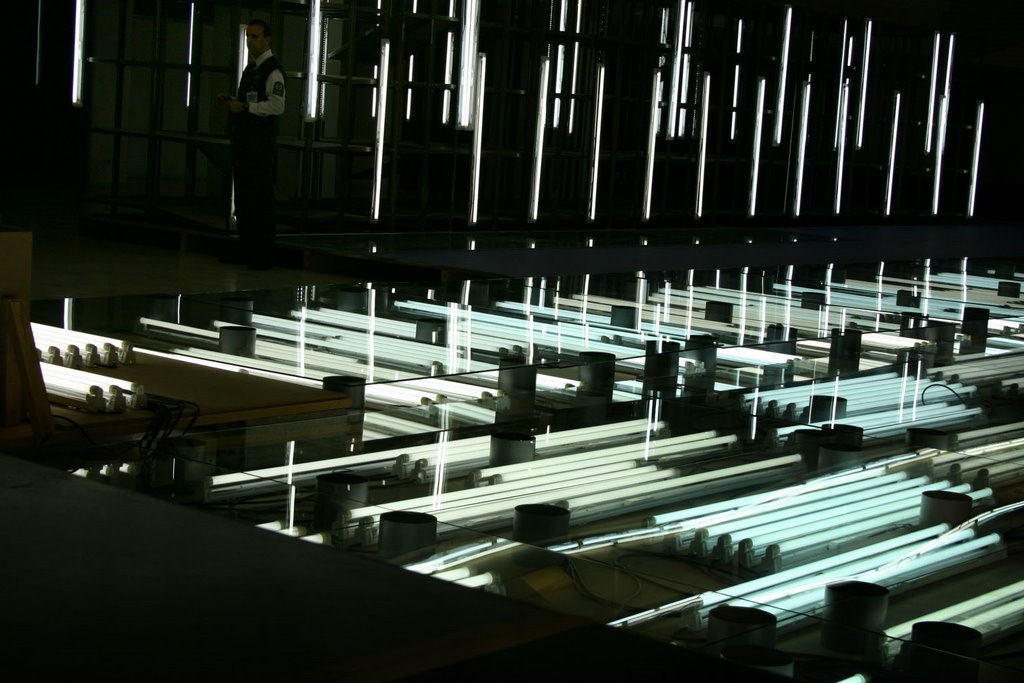
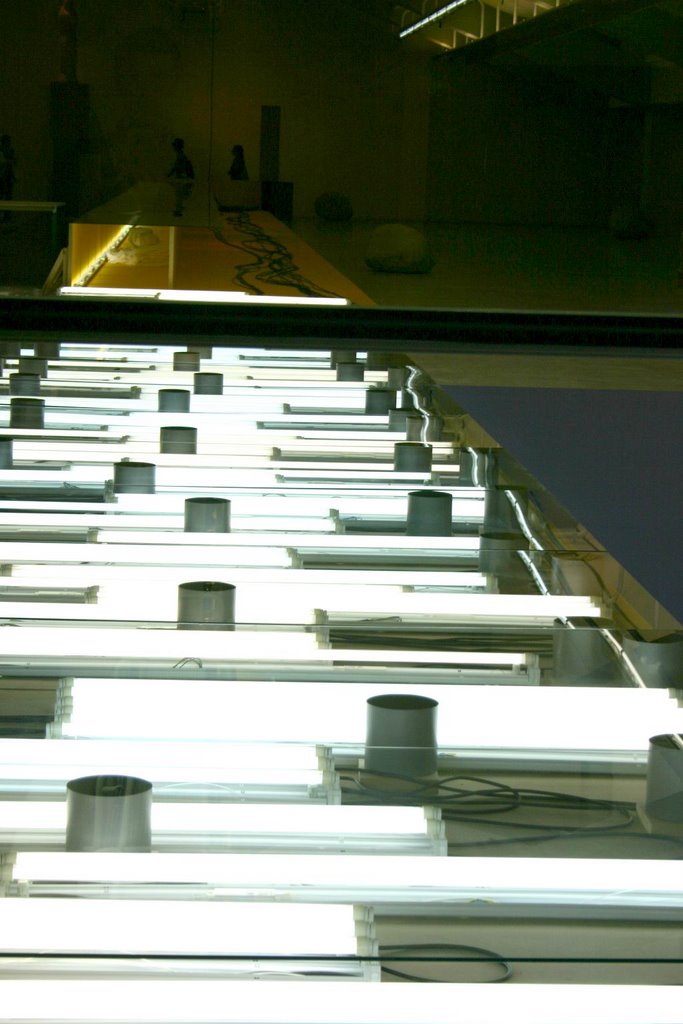
It is constructed. It is not freely distributed. It has a structure. It is the structure it has. The lights have rhythm. The lights are the chaotic order that sustains. They... some are covered with glass. Like a mirror of water. But their transparency doesn't support. Is it protected by those tables? Can we sit on the tables? And what about the guard? Does the guard know he is performing? I suppose so - both him and his colleague try hiding every time I take a picture. What is this light for? What lack of purpose? Who can I ask? Can I ask? Look at this red, look at this brown, look at this gray. Does it ring a bell? Does it ring? And once again: what are we shedding the light on? What foundation? What does it matter? After all, if it is THE FOUNDATION, shouldn't it matter? Those damned neon lights don't even shed the light, they produce it and let it go...
Something apparently useless, apparently stumbling, ending, losing itself, or outdating itself? Then, as long as you persist, as there is another structure, and another, as there is a view, and a point of view, and a work, a body of work, you just find yourself within it,
if you please.

And as a bonus, you get an engraving of an actor in a Japanese opera, from the wonderful exhibition of Japanese engravings, also at the Gulbenkian Foundation, only in the Library building.


Tuesday, October 31, 2006

Pedro Cabrita Reis - «Foundation» at the Gulbenkian Foundation


Foundation is, of course, the Gulbenkian Foundation. I have myself had the chance to discover some of the Foundation's warehouses and storage rooms, and it was an impressive experience. The average visitor has no idea that the two buildings, seperated by a medium-size, beautiful park with a pond in the middle, are actually connected underground. And I suppose that's where most, if not all, of the material for Cabrita Reis' work comes from. Neon lights, glass plates, old tables and shelves, cables, more cables, boxes, fragments of stairs, marble bases for sculptures, huge stones... The guts of an institution renowned for its clean, effective approach. The entrails we shouldn't be seeing, impressed as we like to be by the harmonious landscape designed to be seen from the outside, never from the inside. What is the impression now? How does it change our perspective, our view of the basis? The Gulbenkian Foundation can afford this self-irony. It is generous enough, and has good enough taste.

Is this ridiculous? Shouldn't we be analyzing something else? After all, Foundation is, of course, not just this foundation, but the foundation of something, the basis, the beginning, the rule - what Germans call Grund. Knowing Cabrita Reis' work to be often focused on the art world and museum institution as such, this might be the foundation of art, the real foundation of art, apparently chaotic, meaningless, or at least incomprehensible, often unaccessible (we can walk on some parts of the installation, but in an arbitrary way it is decided by the guards that we cannot walk on other parts), complicated, complicated, overwhelming... and yet, somehow harmonious, fitting, as if there was space for us, as if there was space for what we do, for our creation and our appreciation, for free-associating and even squatting on a stone, if we insist (although I haven't tried that, the guards might react).
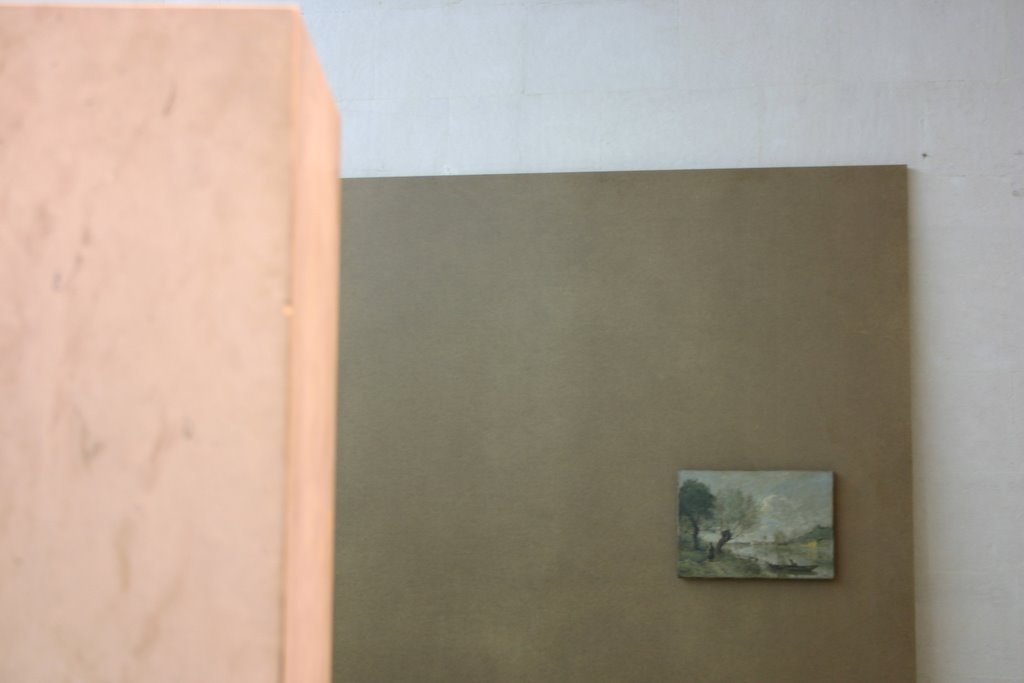
If all this can be dwelved into, then why do I prefer to describe the Gulbenkian warehouse? Maybe because the one thing that's difficult to comprehend is how direct this link is. We are there, at the Center for Contemporary Art of one of 10 richest foundations in the world. And yet, this is the way it works. This is the foundation. It is a complex game of basic elements. Of course, with a Corot stuck somewhere to a wall.

Saturday, October 28, 2006

On Performance Art, In Lisbon


At last! Some good quality theoretical debate about performance, in Portugal! This is a very unexpected early Christmas gift.
With artists such as Rui Horta and Pedro Tudela, and among the curators, Isabel Carlos and the Portuguese star-curator Delfim Sardo, this is going to be a delicious series of conferences. Considering performance is one of the crucial languages of today's art, this is a must-see.

This series of lectures takes the practice of performance in visual arts as departure point, with a view to covering certain thematic extensions that contribute largely to the definition of the individual nature of each performance.
In addition to an historical approach, the lectures will concentrate on these thematic extensions, thanks to the contributions of a group of speakers from different fields, work areas and artistic domains.
More on the Culturgest site.