Thursday, September 21, 2006

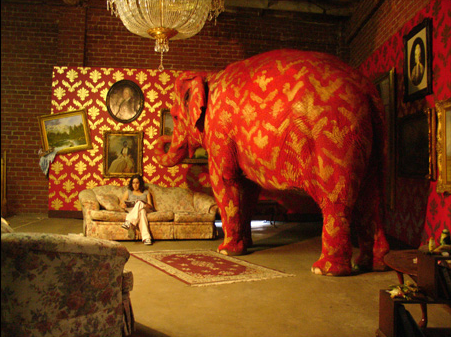
Banksy exhibition...gallery-style


See this great text by Valerie Palmer about a recent Banksy exhibition. The elephant was apparently a fitting centerpiece and stole the show from the political ideas we're used to seeing from the British sweet-painting rebel. Bottom line:
The power of his work lies in the way it interacts with its environment and that obviously gets lost when you put it in any kind of gallery setting.
I guess my wish came true.
Question: Is there any way for revolution to go mainstream?
My answer: No.
Question: What about Cattelan?
My answer: Come on, that's softball compared to Banksy. Cattelan's subversion is a Viennese Waltz compared to Banksy's creative punk attitude.
Question: So how can a guy like Banksy gain recognition?
My answer: He's got it already.
Question: More recognition?
My answer: What's the point? To "promote his values"? Let's face it: the value of critique is that it criticizes. Once it becomes part of the game, it smells of hypocrisy.
Question: What about subversion? Isn't that an option?
My answer: Possibly.
My answer after having though about it for a minute: But there's something cynical about it, isn't there? While in the case of Banksy, there hasn't been so far.
Question: Well, how is he supposed to make a decent living?
My answer: I don't know - find a sponsor? Hell, if I knew, I would be doing it already.
My alternative answer: Just as the jester's role used to be an intelligent critique, also of the ruler, and he made a living off it, so there might be room for an official jester... In the best of possible worlds, that is.

Tuesday, September 19, 2006

Style. Beyond the individual


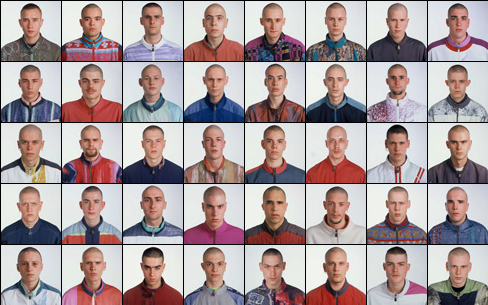
Exactitudes (= exact attitudes), by photographer Ari Versluis and stylist Ellie Uyttenbroek, is an exercise in style (or rather was, from 1994 to 2002 - it is now present online, in a traveling exhibition and in the form of a book). Style is what makes the person unique, but also, quite paradoxically, what makes her so easily categorized. Some say the search for identity isn't at all a search for authenticity (which is a controversial concept), but rather, a search for style. Identity, here, would mean a sort of a definition that allows one to make a drawing. So here we have it, those young boys are making the drawing of themselves - they are getting themselves defined, they are become unique, and totally anonymous at the same time.
It is quite an exciting balance/game/tension, between the self-as-unique and the self-as-participating. Exactitudes shows it clearly. Maybe a little too clearly. It might be because the work is somehow dated, and that, beyond the fact that styles have evolved quite a bit (another proof that identity might be more about style than we think). The pictures, their esthetic qualities, but also the way it was made: the styling, the forcing into categories. Is it necessary? The argument, found in the "about" part of the page, that everything is stylized anyway, simply doesn't seem enough. That's why the groups that speak most to me are ones where the difference, and the similitude, are there, impossible to hide, like in the Tattoo Babes series, or the Dreads one. The others often seem forced, as if the similarity sometimes wasn't enough and needed to be underscored - and it really needn't! Maybe in these two cases, the presence of the naked body seems like something more honest, less manipulated? Then again, come and think of it, the tattoos could be fake.

Saturday, September 16, 2006

Al Magnus: taking children seriously

For Al Magnus, it all started with having children.

How surprizing is that? Of course, these are images of fairly tales. Some actually ring a bell. Most are rather fairy tales in themselves. But to start off, remember they were not meant for us, but for the little ones. Hopefully, that can be a good enough excuse to enjoy, as we usually enjoy the things that weren't meant for us.

Then, of course, there is more. The above image, called Paisagiste II (Landscape Designer II) has two versions. The first one is in color. This one, however, is quite different. By taking away the color, the general atmosphere becomes heavier. But there is another change. The boy pulling on the rope all but disappears. (Yes, there is a boy pulling on the rope). Suddenly, we discover the designer is not quite the one we thought it were. Maybe, because in the tales we know, we can only think of one designer.
But isn't the designer someone with the power to reinvent? To construct, but also, to make a Very Silly Thing (La Grosse Betise)?
Maybe, the power of attraction of children's tales is not that they're far-fetched, incredible, fantastic, but that they design things in such a way that we feel this world-changing design on every step? This is a big difference, since we rarely associate children's stories with the creation of order. Come to think of it, it is an order that they have in common with some, maybe not all, art. And so, the trivial idea that artists are the adults that remained (or went back to being) children can be understood in a whole different way. Artists treat designing seriously.


Wednesday, September 13, 2006

For V.

The work, by Maarten Vanden Eynde, is called Rave Nature, but here is something interesting: the photo's file on the artist's server is named podium. I much prefer this second name. Also, as we can read here, contrary to many other works of land art, the work as such was not the picture, but the thing itself. It was part of a festival, and was actually an installation that at night would be lit with disco lights and a stroboscope, and smoke would come out while a song would play... I'm not really sure if I still enjoy it as much. One thing is for sure: this picture certainly doesn't convey the idea of rave. Which might be part of the trick, come to think of it. As if the stage was set, but impossible to comprehend during daylight? On a more general level, it's fascinating how the opening of interpretations, as would be the case without the night party, leaving the stage as is, at the same time attracts (makes it more enigmatic) and repels (oh, yah, I get it, conceptual work, got the concept, let's go). Is it cat vs. dog? Is it about the work (over)interpreting itself? Two other pieces by the artist I particularly appreciated:

Both are from the Genetologic Research series. The second one seems to only really gain power when seen in the physical space, but we get the point.

Remixing stuffed birds


Pour les dents d'un blanc éclatant e saines (meaning: for teeth that are shining white and healthy) is an installation by Jeroen Diepenmaat. In it, stuffed birds play records by putting their bill into the groove. One of the impressive things about it is that it's not one of those suggestive works that actually only work as a symbol. It works! On his site you can listen to the sound this and other installations make, or you can choose to chill out to some collaborative re-mixing he's been making. All his works seem to be evolving around vinyl and old cars, and often include interesting ways of callaborating with others (artist, students, groups of unsuspecting passers-by...). Speaking of vinyl, it's impressive how old-style vinyl lovers keep reinventing themselves. Is there anything better for creativity than apparently disqalifying limits? Could this be a difference between the amateur and the professional? The amateur doesn't need limits to his areas of investigation...
(via)

Tuesday, September 12, 2006

In these dark days

Oh, entertain me, do entertain me, make silly things, funny things, call them art, call them rat, but make them pleasant and direct and, why not, simple, and use the tongue of greatest lovers, the tongue that tickles, that brings emotions to the flower of the skin, as the Portuguese like to say...


More here.

He's for a jig or a tale of bawdry, or else he sleeps. - Hamlet


(via)


Sunday, September 10, 2006

September 11


***

I found the second of these two works by Peter Coffin as an illustration to this article by art critic Jerry Saltz. Two other discoveries Saltz provides are the Strange Powers exhibition at the Creative Time gallery (unfortunately judging from the participating artists, and not a visit...) and a quote by Erik Fishl:

Imagine calling two pets, one a dog, the other a cat. Asking a dog to do something is an amazing experience. You say, "Come here, Fido," and Fido looks up, pads over, puts his head in your lap, and wags his tail. You've had a direct communication with another species; you and Fido are sharing a common, fairly literal language. Now imagine saying, "Come here, Snowflake" to the cat. Snowflake might glance over, walk to a nearby table, rub it, lie down, and look at you. There's nothing direct about this. Yet something gigantic and very much like art has happened.

A few questions: If the dog stands for entertainment (as I believe it could), doesn't it value entertainment? I mean, in this example, why would the cat always be the better of the two? Don't you ever get the feeling the cat simply doesn't get it? And what about cat cynicism? Where does that leave art amateurs, huh?

Found thanks to the nonist