I rarely do it, but it's worth it. The following is my translation of an article by Dorota Jarecka that appeared yesterday in the Polish newspaper Gazeta Wyborcza.
The Project Próżna 2006 breaks with the sentimental-folk climate of the "Singer's Warsaw" festival. Nobody here tries to prove that one can return to the past, bring it back to life or play it back.
The Ulica Próżna 2006 Projectcurator: Krystyna Piotrowska
until September 10, Warsaw
Every year the "
Singer's Warsaw" festival attracts people to the otherwise deserted Próżna street and creates a fiction. The forgotten climate of a forgotten Warsaw appears again. The artistic project in the building at Próżna 7/9 is a whole other story: no orchestra rhythms, no singing cantors, no Jewish cuisine or cut-outs. Here nobody tries to make anyone believe that the one can go back to the past.
It's a rather painful than happy contact with the past, and the pleasant feeling of participating in a fiction is questioned and treated mistrustfully. The building was designed in the 1880's by the architect Brauman for Naftal Perlman. It was later bought by Zelman Nożyk, founder of the synagogue on Twarda street, the only one in Warsaw to survive the war [WW2]. The building extends along Próżna street, it has several entrances and reaches as far as the Grzybowski square. In 1940 it was inside of the first large ghetto. In the summer of 1942 the ghetto border was diminished and the building was left on the outside. That's why it wasn't brought down after the collapse of the 1943 [Jewish ghetto] insurrection. After the war it had state-owned apartments. Nine years ago it was bought by the Lauder Foundation, who sold it two years ago to a developer called Warimpex.
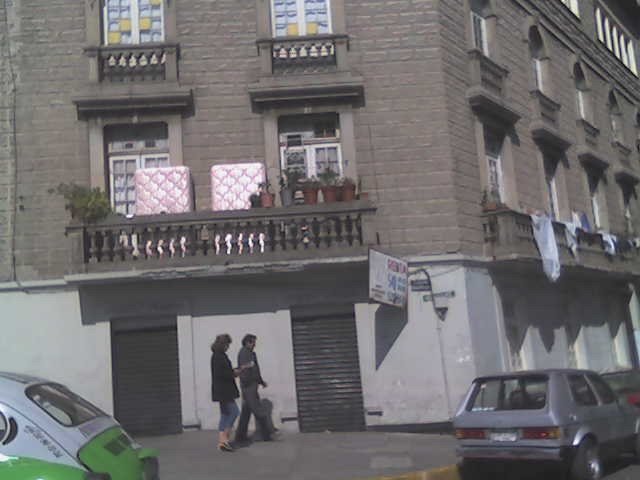
The house, together with a few neighboring ones on Próżna street, are something unique in Warsaw, since it survived both the Warsaw Insurrection [in 1944] and the reconstruction of Warsaw, but they also didn't undergo nearly any remodeling or improvement. They look just about the same as they did in 1945. When the Lauder Foundation bought the house, the locators renting apartments had to move out. There is always someone there in the abandoned houses, ripping out the old tiles or stealing the balustrade. The water pours in through the roof. We can check by ourselves: in the last years the house at Próżna 7/9 turned into a ruin. It would require an archaeologist to distinguish between war damages and the devastation of the last few years. All the signs mixed together. The house is a conglomarate of damage.
That is the house that artists have entered. Since the very first meeting with art here, we are nearly swept off our feet. Katarzyna Krakowiak, a young sculptor (teacher at the Academy of Fine Art in Poznań), filled the floor of one of the entrances with sidewalk tiles. They give to the first step, caving in. We discover they are laid on an air-filled, rubber foundation. We walk as through concrete waves, on a shaking ground. The work is called "Swindle of Balance".
Another work present was Artur Żmijewski's "Our Songbook". It consists of a film made in Israel - emigrants from Poland, 60 to 80 years old, sing Polish songs. It is an astonishing document. It shows there are no easy national qualifications. Żmijewski says: there are limit identities, fluid ones, impossible to name by a political or media language - and even less by the language of official passports. In his film, the artist shows the counsciousness of a specific group of people living in Israel, but one which is neither the consciousness of all Jews, or of all Poles.
The "Ulica Próżna 2006" project is exactly such a collection of individual messages. Krystiana Robb-Narbutt created a narration about her family which didn't survive the ghetto. It is made of toys inside of glass aquariums. The history is told with a naive language, seemingly inadequate to the events. Yet the subject is the very search for a language. The props used in this story (the toy wagon stands for the transport, the Christmas decoration "angel hair"[bands of very thin stripes of translucid plastic] is the grey hair of an old woman) are a conscious choice of an immature language. Because any other language lost its value and can no longer tell the story.
The common language becomes ridiculed. Something is "Jewish", something is "Polish" - but what does that mean, exactly? In Krystyna Piotrowska's installation, a real, live carp swims in the bathtub. Next to it, the artist put two recipes for carp taken from an internet cuisine book - carp "Polish style" and carp "Jewish style". The Polish one is a little more caloric, but it's pretty much the same. And the carp doesn't know what nation it belongs to.
A wooden model of Próżna street, as it is to look after the remodeling (to be made in near future), stands in one of the rooms. The developer wants to create a luxurious hotel in this building. The empty, enormous apartment on the second floor where I managed to enter, with the traces of the old life, with the colors of the old paints still on the walls, will be gone.
Próżna street cleaned of its junk and cleanly painted is a problem for me. In Poland what tells something about history is not reconstructed antiquities, but crumbs, wrecks, litter. The flashy, crystal clean street will stop being Próżna [meaning "Void" or "Vain"] and become Empty street. Yesterday, walking through the house at Próżna 7/9, I had the feeling that I'm walking through the real museum of the history of Polish Jews. How can we save it?
- Dorota Jarecka
Extra: from the curator's note:
The way Próżna street looks makes it completely visually autonomous from its surroundings, the current center of Warsaw. It puts it in an aesthetically and historically provocative oposition to the contemporary city. It constitutes a dramatic shock of a dead and decaying fragment of the city of the past with the live and indifferent city of today. It is the image of a conflict that is both ethical and aesthetic. It is the fruit of a German crime from times of War and of the post-war indifference.
Such a dramatic tension in the city space is an inspiration for the creation of the Artistic Project "Ulica Próżna 2006". The goal of the project is to show how the newest language of art can relate to this past and this present, which the opposition of Próżna street with its surroundings calls upon. (...)
The Artistic Project "Ulica Próżna 2006" is also open to interpreting it from the perspective of such contemporary phenomena as cultural, religious or political foreignness and animosity. Also today, they lead towards crime on a mass scale. - Krystyna Piotrowska (Polish fragment here)