Tuesday, September 5, 2006
Darker
I have just played the internet version of Russian Rulette, by Carlos Katastrofsky. This is what I got:

Monday, September 4, 2006
Easy still
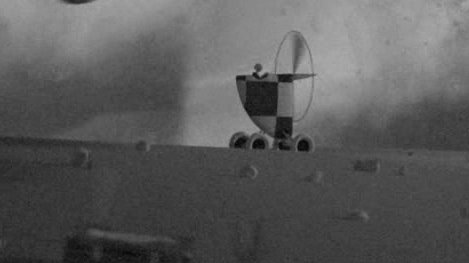
Yes, we are still in the slow, gentle recovery zone. That's why all these really sweet links. Here is another one:
The story is too easy, etc etc. But let's just let it go for now.
Enjoy the fall of an angel. By Geoffroy Barbet Massin, produced by the digital editing studio Mikros Image.
I once asked Alex Kelly from Third Angel, who was a teacher of mine, what he did when he found something was too pretty, so pretty it was unbearable, like kitsch, but not really kitsch, only too pretty. He answered, "there is no such thing as too pretty. Enjoy it."
Saturday, September 2, 2006
Oh, why not


All paintings are by Esao Andrews. He also designs skateboards, in case you're interested. Here is an interview with the talented young man. Oh, and if you see his photos (on his page), mind you those are ballerinas' feet.
Wednesday, August 30, 2006
Freezing frames
Welcome back! A special welcome to my friends in Lisbon, Warsaw, Brussels, Montreal, Paris, Georgia, Coimbra, and to all the others who have been dropping by to see if I'm back yet. I'm really happy to find that you seem as anxious to see new art as I am.
Now, back to business.
For starters, let's take it nice and easy.
A few charming games with the stop-motion technique (taking still pictures and turning them into a film):
 Pika Pika is an animated light pen/flashlight project, with some impressive results. (notice these are all GIF animations and not films). It inspired some other grassroots projects, here made to a remix of 3-year-old vocal artist MC Leozinho.
Their Circular Life is about time passing. Don't be misguided by the simplicity of the concept - to make something of this purity and precision must have been extremely difficult. Elegant, delicate, to the point. I just wish they spared us the philosophizing in the introduction. The work could really do without someone else thinking about it for us, or suggesting a reading that I, for one, find diminishing, not opening new horizons. That's why I would recommend skipping the introduction.
Finally, Human Space Invaders, part of the Game Over series by Guillaume Reymond from the French design group NOTsoNoisy. It will certainly remind some of you of the Human Tetris, but it has its own original style. It's also hilarious, but more sophisticated. It's impressive how even in these "simple" games with games the execution, the form says so much.
(partly via)
Now, back to business.
For starters, let's take it nice and easy.
A few charming games with the stop-motion technique (taking still pictures and turning them into a film):
 Pika Pika is an animated light pen/flashlight project, with some impressive results. (notice these are all GIF animations and not films). It inspired some other grassroots projects, here made to a remix of 3-year-old vocal artist MC Leozinho.
Their Circular Life is about time passing. Don't be misguided by the simplicity of the concept - to make something of this purity and precision must have been extremely difficult. Elegant, delicate, to the point. I just wish they spared us the philosophizing in the introduction. The work could really do without someone else thinking about it for us, or suggesting a reading that I, for one, find diminishing, not opening new horizons. That's why I would recommend skipping the introduction.
Finally, Human Space Invaders, part of the Game Over series by Guillaume Reymond from the French design group NOTsoNoisy. It will certainly remind some of you of the Human Tetris, but it has its own original style. It's also hilarious, but more sophisticated. It's impressive how even in these "simple" games with games the execution, the form says so much.
(partly via)
Sunday, July 30, 2006
"Me, You and Everyone You Know": Filming art, Arting film

Seeing the film Me, You, and Everyone You Know, I kept getting the impression that it's a series of performances and installations, rather than an actual "life-like" story. They all had a punch, they were beautifuly written, conceived... and that was strange. Something unusually pure about it. Of course, it isn't about the film being "unrealistic". It is about it being a specific type of creation. And I'm afraid I'm having some difficulty describing just what that is.
But take some specific qualities of the film: the characters are sketched rather than painted. Sketched quite well, but nonetheless - they are hinted at and not "described". There is little or no small talk, nothing that can allow us to go deeper, beyond the surface of an action. I believe this is because at the heart of the work lies the need for composition, understood as the composition of a painting or performance rather than the composition of a character. The actions, events, situations, always seem to point to, or refer to, or use the language of, contemporary art.
Example: the two boys, both beautifuly discreet and calm characters, make ASCII drawings. And at a certain point, one of them shows the other a drawing he invented: a map of the neighborhood with "me and you and everyone we know" on it, in the form of dots. It might sound as a perfectly normal thing for boys to do. Well, it's not. And the level of asbtraction is quite high. Which doesn't mean it would be impossible for a twelve-year-old to come up with something of the sort. But it has the fresh scent of good contemporary art much more than of the spontaneous creation of a young adolescent.
It makes the entire experience of watching the film an unusual one. Of course one can enjoy it - it's a great picture - but once you feel what I'm trying to tell you, you simply can't stop thinking of someone writing it. Creating it. Composing it, like some installation.
Guess what. The director and star of the film - Miranda July - is actually a pretty renowned visual/performance/etc artist. This is her first feature film, and until now she has been doing installations and performances, many of which quite similar to the ones her character makes in the film. She is also the co-author of a brilliant web project that has been blogged about quite a lot, Learning To Love You More.
Doesn't this bring a lot of issues to the table?
If visual art can fit so well in a feature film, why not keep with the latter format? Isn't it more important, given the total lack of interest of the wider public towards contemporary art and the amazing success of the film (Golden Camera in Cannes, etc...)?
How close can a film, as in, regular saturday night film and not andy warhol film, be to a visual art work? Can't we judge it as such?
How does our judgement change once we accept something as a film or an installation /video art? Of course it does, and tremendously so. But isn't there something to be discovered by each of the disciplines - in the way we see the other work? For instance, for me a film is much easier to accept as such, to follow, to believe in, while video art creates great spaces for asking questions, for changing my approach, from a dynamic to a contemplative state. Oftentimes, though, the video art could use a little of the pragmatic follow me approach of a film, and vice versa, a film could use a little games with distance, so we can breathe.
Another issue: does the more accessible film equipment (Me, You... was shot on video, though it's still damn expensive video) mean that there is space for artists to go into/play with the more mainstream stream? Or is still going to be an offense to even think of mixing the two?
These questions are sometimes schematic, because I feel a need for schemes, for perspectives, points of view.
It's nice to know Matthew Barney is not the only visual artist making feature films. Although we shouldn't forget there are film directors who also make visual art (Lars von Trier, Peter Greenaway...).
ps.: Miranda July also wrote a blog, openly admitting it was part of the indie film industry strategy to promote the film. Nice nonetheless.
Friday, July 28, 2006


Thursday, July 27, 2006
Toy Piano - why is Margaret Leng Tan so fascinating?
The European Mezzo TV channel tells you everything about "culture" you need to know:
1. It is a ridiculously small milieu. Just look at their site. It is not much more developed than your average friendly grocer's home page.
2. It is snobbish. Ubearably snobbish. It does not intend to introduce art to new audiences, it does not intend to render the experience of art more... well, more anything than it already is. You need to get it, to get it. Just look at their site. The few introductions to future programs are ridiculously small, superficial and badly translated ("she inflames the audience"....).
3. It has no money. Just look at the site.
4. It seems not to care. It makes no effort to be user-friendly (the TV program on the site is in Excel, for the love of God!).
5. From time to time, it brings you the most delicious moments you could ever have hoped for.
Margaret Leng Tan's recital was such an enlightening moment. Leng Tan plays the piano. She comes out of the vein of John Cage. And moves forward. How can you move forward after Cage? Are we not stuck, as after any serious avant-garde artist? It might almost seem a permanent paradox: the true revolutionaries leave little space for their students. But if you look carefuly enough, there is plenty of room for others. And so, Leng Tan, after playing around with several of Cage's games (she is a Julliard graduate, so that meant mainly prepared pianos and such), tried the toy piano.
Today, she is considered the magician of the toy piano. Moving consequently into the exploration of the "toy sound", she established herself as a real master.
But Lang Tan is not my main interest here. What I found curious about what I saw was that the sound of the toy piano is so fascinating. Is it because it's a toy? Because it's so "simple", "naive"? Because it wanders around the frequencies, often destroying the "natural harmony" completely?And if so, what is it about this that attracts us? Maybe, and this is just a hypothesis, it's because this childlike simplicity is a relief. We can step down from the pedestal and actually enjoy it, without necessarily appreciating it as the scholarly art amateurs we are does. The playfulness is nearly destructive, it almost breaks the whole illusion of art, but then, not quite. It maintains the charm, the power, and yes, the beauty, while allowing us to move away. Only what sort of movement is it? Is it really the creation of distance? I would say it is rather assuming a distance, taking it as a starting point, which allows to be as close as we wish, making up our own rules, our private relation to the piece, uncontaminated by the judgement of style, technique, interpretation. That does not mean all of these elements do not play a role - they do. But we are happy to stop judging it, to put ourselves into the oblivion of spectatorship.
This became clear when Lang Tan played a very well known piece, Mozart's Turkish March, and I started listening to the interpretation, the technical aspects, the mistakes, and it wasn't as appealing. What I really needed was something simpler, easier maybe, but more immediate, more bare, less dressed up in the fancy clothes of "culture".
This brings me to another point, which could be developed: aren't the minimalist works - that have been appearing in the last couple of decades in various art fields - this type of search for a bare art? An art that, beyond the discussion of "hi" and "low", starts with an "a-b" that allows us to enter easier, to travel further, and to feel more at ease, just as if this were a simple toy, that by some chance (which, as Cage knew well, has little to do with chance, although it can spur from coincidence), by some chance becomes this: good.
Listen to Margaret Leng Tan here and here. I must admit, though, that these aren't the works that impressed me most.
1. It is a ridiculously small milieu. Just look at their site. It is not much more developed than your average friendly grocer's home page.
2. It is snobbish. Ubearably snobbish. It does not intend to introduce art to new audiences, it does not intend to render the experience of art more... well, more anything than it already is. You need to get it, to get it. Just look at their site. The few introductions to future programs are ridiculously small, superficial and badly translated ("she inflames the audience"....).
3. It has no money. Just look at the site.
4. It seems not to care. It makes no effort to be user-friendly (the TV program on the site is in Excel, for the love of God!).
5. From time to time, it brings you the most delicious moments you could ever have hoped for.
Margaret Leng Tan's recital was such an enlightening moment. Leng Tan plays the piano.
 She comes out of the vein of John Cage. And moves forward. How can you move forward after Cage? Are we not stuck, as after any serious avant-garde artist? It might almost seem a permanent paradox: the true revolutionaries leave little space for their students. But if you look carefuly enough, there is plenty of room for others. And so, Leng Tan, after playing around with several of Cage's games (she is a Julliard graduate, so that meant mainly prepared pianos and such), tried the toy piano.
Today, she is considered the magician of the toy piano. Moving consequently into the exploration of the "toy sound", she established herself as a real master.
But Lang Tan is not my main interest here. What I found curious about what I saw was that the sound of the toy piano is so fascinating. Is it because it's a toy? Because it's so "simple", "naive"? Because it wanders around the frequencies, often destroying the "natural harmony" completely?And if so, what is it about this that attracts us? Maybe, and this is just a hypothesis, it's because this childlike simplicity is a relief. We can step down from the pedestal and actually enjoy it, without necessarily appreciating it as the scholarly art amateurs we are does. The playfulness is nearly destructive, it almost breaks the whole illusion of art, but then, not quite. It maintains the charm, the power, and yes, the beauty, while allowing us to move away. Only what sort of movement is it? Is it really the creation of distance? I would say it is rather assuming a distance, taking it as a starting point, which allows to be as close as we wish, making up our own rules, our private relation to the piece, uncontaminated by the judgement of style, technique, interpretation. That does not mean all of these elements do not play a role - they do. But we are happy to stop judging it, to put ourselves into the oblivion of spectatorship.
This became clear when Lang Tan played a very well known piece, Mozart's Turkish March, and I started listening to the interpretation, the technical aspects, the mistakes, and it wasn't as appealing. What I really needed was something simpler, easier maybe, but more immediate, more bare, less dressed up in the fancy clothes of "culture".
This brings me to another point, which could be developed: aren't the minimalist works - that have been appearing in the last couple of decades in various art fields - this type of search for a bare art? An art that, beyond the discussion of "hi" and "low", starts with an "a-b" that allows us to enter easier, to travel further, and to feel more at ease, just as if this were a simple toy, that by some chance (which, as Cage knew well, has little to do with chance, although it can spur from coincidence), by some chance becomes this: good.
Listen to Margaret Leng Tan here and here. I must admit, though, that these aren't the works that impressed me most.
Subscribe to:
Posts (Atom)