The history of contemporary dance knows many attempts at pinning down the choreographic composition. None of them is perfect though - and the main flaw is that they are mainly character-based, i.e., they create signs to represent movements. This semiotic approach has obvious limitations - the purity of movement, its dynamic and time is gone. Also, it takes a long time for someone to understand how a system works, so as to repeat it, or even read it correctly.
Simply recording on video also isn't enough, as it lacks all the advantages of symbolic transcription: yes, you can see what's happening, but how are you to explain it? How are you to know if what you're doing is the same? It all requires quite a lot of imagination, and one usually ends up confused and unable to really "get the real thing".
So how is a choreographer to mark down what he's come up with?
Here is a new, pretty solution:
Rotosketch is an intuitive tool for sketching, doodling and notating on top of video, such that the marks that are made are linked in time with the video. This allows the user to draw strokes along the the axis of time, as well as the normal x and y axes, and for those strokes to augment, analyze, interpret, or even obliterate a video sequence.

ps: Following the comment that "this has been done before. done a lot":Yes, it has. Using software to work with choreography has an entire history, that goes back at least to the great
Merce Cunningham's 1989 performance with the program
Life Forms. There were - and are - many other choreographers and programmers that followed. I'm not specialist on the matter - read more about it
here and
here and
here. (Some examples of software are
Isadora, the
Choreograph, the
Chaographer and the
Interactive Choreographic Sketchbook). However, what seems to me particularly appealing about the Rotosketch is a combination of factors: 1) the possibility of including time as one of the variables in the sketch; 2) the "photoshop" characterisics that make it easy and intuitive (just use the pen and pad...); 3) the availability of the software (free
download on the net); 4) the possibility of playing between the level of choreography and drawing. As you can see on the
video, the sketch is really an interpretation of the draughtsman/analyst, allowing for a more personal, less software-dependent approach.
(
via)
Technorati:
art installation, performance art, performance, dance, art, contemporary art, new art, vvoi, vvoitek, modern art, cool
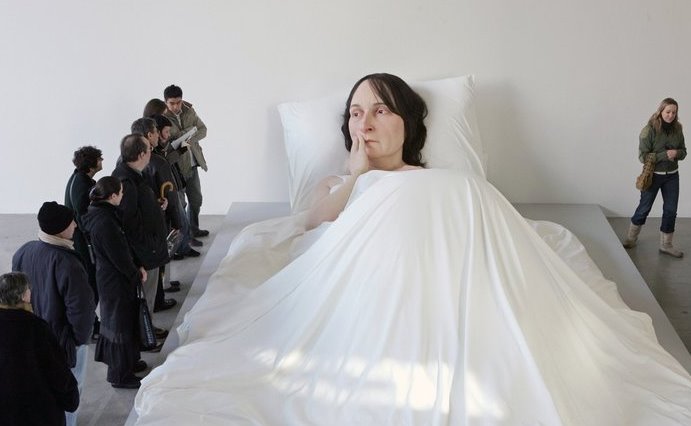
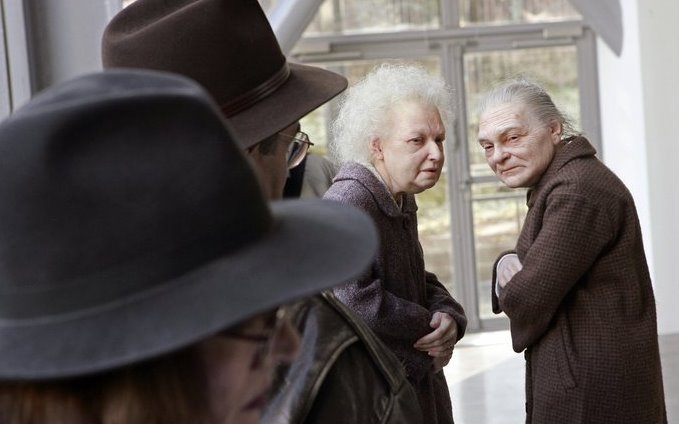 What I like in Ron Mueck's work is not so much the "life-likeness" of the figures (that has been done and re-done). It is their dramatic character, their theatricality. They have their stories, personalities, they are not types of people (like Duane Hanson's characters often were).