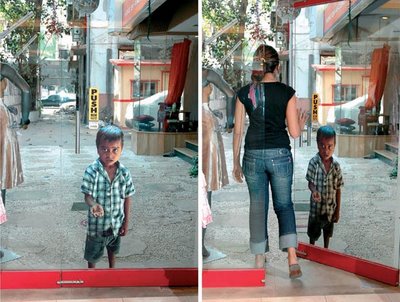
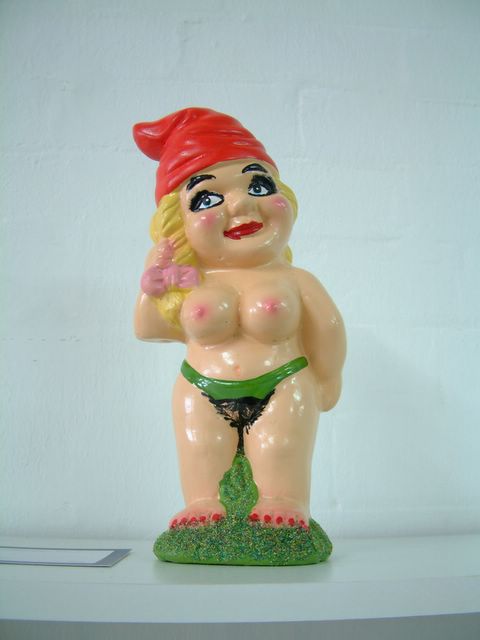
Wim Delvoye,
Betonmolen (Cement Mixer) (1992)

Margaret Wharton,
Chair (1980)

Ernesto Neto,
Body Object (1999)

Allan D'Arcangelo,
Smoke Dream (1963)

Antony Gormley,
Bearing (1993)
I've seen a part of it on exhibition, some two years ago, in
Sintra near Lisbon. I couldn't believe my eyes.
The Berardo Collection made a big impression even on my dull and ignorant senses (yes, I firmly believe ignorance dulls the senses). What were these masterpieces doing in a tiny, tourist-oriented town? Of course, Sintra's history is associated with artists (I believe Byron called it "paradise on Earth"), but let's be honest - this stopped about a century ago. And if there is one thing few visitors care about, it's going to see a contemporary art exhibit. Fortunately, the Museum of Modern Art didn't seem to mind, and has been showing a part of the Berardo Collection for several years now. The problem was - the Museum was really no match for this very large (4000 pieces) and diversified (besides modern art, it has notably an impressive poster collection, as well as porcelain, coin and book collections) set. It was too small, and, frankly, simply not quite "cosmopolitan" enough. At least in a country with such a deficit in the appreciation of contemporary art.
The talks with the various Portuguese governments were endless. When I arrived here nearly 4 years ago, there was already talk of a total failure. Through this time, I heard close to nothing of the collection. I know that José Berardo, the businessman who created the collection, got really tired, and mentioned several alternative countries willing to host the collection (France, Italy, U.S.). And
now this: the Portuguese government (whose minister of culture has been under great attack of the artistic milieu) has finally made a deal with Berardo. It will be exhibited at the highly prestigious
Belém Cultural Center (which is
the best place in Portugal culture-wise).
The Berardo Collection is exciting for similar reasons the
Gulbenkian Museum is - it was created by a single art-lover with a great sensibility* and significantly too much money. As was the case with Gulbenkian, Berardo opted not to buy the most renowned (expensive) works, but to try and find less known ones with first-rate quality. This makes it somehow less attractive to the average museum-goer or art amateur, and I must admit there were many works by artists I was interested in that I found difficult to
digest. On the other hand, when I knew some artist slightly better (or even are more used to a certain language), the work you find (most of the artists are represented by a single work - it's what is called in agriculture and
extensive, not an
intensive culture) really made my day.
You can see all the works from the modern art collection at the
Berardo site (the site isn't the best I've seen, and the "artist movements" sometimes are simply ridiculous - e.g. "postmodernism" (?) and "experimental art" (?) as two separate movements). You'll notice how extensive the spectrum of works is. For me, there is one thing missing though: work from outside the comfortable, Euro-American tradition. There is modern art, contemporary art. Very little really new art though. And very little, for instance, from Central and Eastern Europe (haven't found anything so far!). Of course, art is also a business as any other. New art is a gamble. But the choices (see, for instance, the poster collection, from what I saw 100% American) sometimes seem more related to a certain lack of wider perspective. (Can someone contradict me, please?) Maybe now, when the new museum opens with a year budget of 1 million euro, things will evolve? After all, only 50% of the money will come from Berardo. The other 50% is from the state - and spending state money should be easier, I suppose.
* Apparently Berardo has mainly a sensibility for choosing the right person, as he himself is said to be quite far from having a profound knowledge of art. The person I was told stands behind the class of the collection is Francisco Capelo, himself a great design collector (the great permanent exhibition of the Museum of Design are his adopted babies).
 It is not quite as the artist, Oscar Guzman, would have it - those images are not photos. We can hardly say they have "characteristics of a photographic record", as the author puts it. They are clearly painted, in a style resembling some computer games. But that's where similarities stop.
 PS.: I have just one objection. I would rather not see the focused faces on some of the pictures. They refer me to a particular region, culture, part of the world. I think it's a pity, and not necessary to make our grey cells work.