Friday, April 7, 2006

The Berardo Collection

Wim Delvoye, Betonmolen (Cement Mixer) (1992)
Margaret Wharton, Chair (1980)
Ernesto Neto, Body Object (1999)
Allan D'Arcangelo, Smoke Dream (1963)
Antony Gormley, Bearing (1993)


I've seen a part of it on exhibition, some two years ago, in Sintra near Lisbon. I couldn't believe my eyes. The Berardo Collection made a big impression even on my dull and ignorant senses (yes, I firmly believe ignorance dulls the senses). What were these masterpieces doing in a tiny, tourist-oriented town? Of course, Sintra's history is associated with artists (I believe Byron called it "paradise on Earth"), but let's be honest - this stopped about a century ago. And if there is one thing few visitors care about, it's going to see a contemporary art exhibit. Fortunately, the Museum of Modern Art didn't seem to mind, and has been showing a part of the Berardo Collection for several years now. The problem was - the Museum was really no match for this very large (4000 pieces) and diversified (besides modern art, it has notably an impressive poster collection, as well as porcelain, coin and book collections) set. It was too small, and, frankly, simply not quite "cosmopolitan" enough. At least in a country with such a deficit in the appreciation of contemporary art.
The talks with the various Portuguese governments were endless. When I arrived here nearly 4 years ago, there was already talk of a total failure. Through this time, I heard close to nothing of the collection. I know that José Berardo, the businessman who created the collection, got really tired, and mentioned several alternative countries willing to host the collection (France, Italy, U.S.). And now this: the Portuguese government (whose minister of culture has been under great attack of the artistic milieu) has finally made a deal with Berardo. It will be exhibited at the highly prestigious Belém Cultural Center (which is the best place in Portugal culture-wise).
The Berardo Collection is exciting for similar reasons the Gulbenkian Museum is - it was created by a single art-lover with a great sensibility* and significantly too much money. As was the case with Gulbenkian, Berardo opted not to buy the most renowned (expensive) works, but to try and find less known ones with first-rate quality. This makes it somehow less attractive to the average museum-goer or art amateur, and I must admit there were many works by artists I was interested in that I found difficult to digest. On the other hand, when I knew some artist slightly better (or even are more used to a certain language), the work you find (most of the artists are represented by a single work - it's what is called in agriculture and extensive, not an intensive culture) really made my day.
You can see all the works from the modern art collection at the Berardo site (the site isn't the best I've seen, and the "artist movements" sometimes are simply ridiculous - e.g. "postmodernism" (?) and "experimental art" (?) as two separate movements). You'll notice how extensive the spectrum of works is. For me, there is one thing missing though: work from outside the comfortable, Euro-American tradition. There is modern art, contemporary art. Very little really new art though. And very little, for instance, from Central and Eastern Europe (haven't found anything so far!). Of course, art is also a business as any other. New art is a gamble. But the choices (see, for instance, the poster collection, from what I saw 100% American) sometimes seem more related to a certain lack of wider perspective. (Can someone contradict me, please?) Maybe now, when the new museum opens with a year budget of 1 million euro, things will evolve? After all, only 50% of the money will come from Berardo. The other 50% is from the state - and spending state money should be easier, I suppose.

* Apparently Berardo has mainly a sensibility for choosing the right person, as he himself is said to be quite far from having a profound knowledge of art. The person I was told stands behind the class of the collection is Francisco Capelo, himself a great design collector (the great permanent exhibition of the Museum of Design are his adopted babies).

Thursday, April 6, 2006

Space Invaders


I completely forgot about them. Space Invaders. Are they the cutest thing? Or are they simply a street-art version of Nike? A proof that the "alternative" world is also easy to manipulate into "fun symbols"? Or are they simply fun?

Wednesday, April 5, 2006

Tags/ Categories

I'm fighting hard to get some sort of categories or tags working in here. So far, without any true success, but I haven't given up. BTW, if anyone has any solutions, HELP.

Tuesday, April 4, 2006

Designing better, for a better world

Today, two stories of people deciding to make a difference - and create something beautiful while they're at it.
The first one is the story of a man that lived the American dream until it bored him to death. And he decided to do something good. And he invented a shelter that is something between a tent and a house, fairly inexpensive, pretty, clean, and above all - resistent. Sanford Ponder, who used to work as a manager in Microsoft, created The Pod, which looks like some sci-fi object, and is, well, this:
The beginning of something beautiful?

You need to see the video to get the whole story (a little cheesy, but interesting), and there is a follow-up - this story about the first humanitarian attempt, in Pakistan, and an update.

While the above project was created by someone who was only an amateur designer, professional designers and architects can also have sudden awakenings. Here is the story of Cameron Sinclair, a young architect who discovered he can be just as good an architect while being a better man. Today, he creates a range of projects, from shelters for the homeless to a mobile HIV clinic, etc. etc.

The interview with him is here, here is his Architecture for Humanity. And for more artistic ways of changing the world, see www.worldchanging.com.

More pictures of Ernesto Neto's recent sculpture installation, The Malmö Experience.

Sunday, April 2, 2006

245 Cubic Meters of controversy - Santiago Sierra's latest


How could I have missed this!
Santiago Sierra is back. And, as usual, he's creating a stir. If it seemed to you he's been controversial enough, paying people to be tattooed or to carry stone squares around or to stay walled in during an exhibition, well, this time he seems to have outdone himself.
His project, called 245 Cubic Meters, was
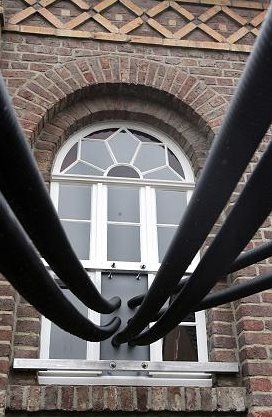
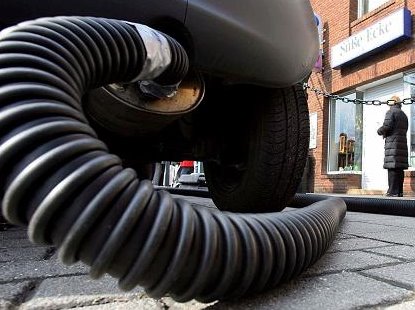
to give people a sense of the Holocaust by pumping lethal car exhaust fumes into a former synagogue and letting visitors enter one by one with a breathing apparatus.
I suppose everything worked out as planned: huge outrage, criticism, and a public debate about art, it's possible role in society and the way it can, should or does influence us.
The exhibition was suspended.

Here is my take on it.
1. I don't agree with the critics that claim Sierra's work is exactly what it claims to fight, i.e., "the trivialization of the Holocaust", as the artist put it. I don't think something becomes trivial just because you make a direct reference to it. Obviously, this isn't Disneyland, and nobody going in there must have made it light-heartedly. This is a very serious, heavy matter. When death is near, it is really too simple to discard it as "trivial".
2. Taking place in Germany, the work can be seen as a cleansing ritual, more than a gesture of rememberance. Many Germans I know never dared to ask their fathers or granfathers what they did during the war (Hans in his note to my last post notes the ever-present figure of the goo-bad uncle).
3. Part of the cleansing is certainly the aethetic aspect of the work. Walking in an abandoned synagogue is a strong emotion. Walking with a firefighter-guide makes it even more surreal.
4. The firefighter is a very strong element. It was misinterpreted by several commentators as the proof of how ridiculous an attempt at restaging the drama can be. Well, I think it rather shows that this is not a restaging. This is a work of art, and is to be treated as such. It tells a story which goes beyond itself. It is not about reliving the moment. It is, maybe, about the possibility of reliving the moment. About the power of a place. Authenticity - yes. But authenticity of a place, of a history, of an event. Authenticity of a gas and of our reaction to it. Of the precautions we take. Today.

5. If Sierra was actually after the creepy feeling that all this was real, if he wanted to "remember", he could have simply made a trip to Auschwitz. It is a horrible, horrible place. I'm still not sure if I think it is a good thing for it to exist. Its struggle for memory gets scarily close to a fascination with death, the same one that makes us look at an accident or listen to a horrible story. Yes, it makes us remember. But I'm not sure if the cost is not, well, some sort of a pornography, if you may, an indecent exposure of something that really should have been put to rest. Nonetheless, it exists - it's there to see for anyone unsure if his memory is correct, unsure if he has enough disgust for what people can do to other people. I don't think we need Santiago Sierra to remind us of that.
6. The difference is that Sierra made his piece in a gallery space. In a synagogue. In Germany. I am really tired of having Poland associated with the Holocaust (I think I mentioned it some while ago). This work puts the finger to the wound. Right where it (still!) hurts.
7. How pretentious to seek to evoke their horror and fear of death in such a cheap way! In a cynical game which yields no insight whatsoever. - says a newspaper.
For some time, Santiago Sierra has been asking one question: "What if it were you?". His works are exercices in empathy. They are often cruel exercices. In this sense, yes, they get cynical.
This reminds me of the famous Stanley Milgram, a scientist often accused of cynicism, who discovered that most people can be unhumanly cruel by creating simple conditions (orders coming from an authority) that made them do what they thought to be acts of great cruelty. Milgram was accused of turning people into murderers, as if they were toys to play with. Sierra is accused of "hurting the dignity of the victims", as if they were toys to play with. I really don't see how the dignity of the victims is being hurt. And, contrary to some of his other works, here Sierra doesn't actually use anyone, he doesn't turn people into something just (?) for art's sake.
8. What he does play with is memory. And guilt. The synagogue is the sign, it is what made the difference when the selection was made during the war, it was what identified the victims and what differenciated them from the others (the killers, but also the by-standers). Here, the visitor becomes at once the victim, the perpetrator and the by-stander, the observer. Being the art spectator he is, he cannot help but have a distance. At the same time, he goes inside, he participates. He repeats history. As a victim, or as a re-creator?
9. To me, this last question is going too far. And not because it crosses some line of decency. Because from what I can imagine and see on the pictures (once again: what can I imagine and see on the picture? how far can imagination get me?), the conceptuality of the work is simply unbearable. Bluntly speaking: it seems boring. It is the second work by Sierra that I find interesting as a concept, but have difficulty finding strong as an actual work (The first one was 300 tons). I really don't feel like walking through an empty synagogue with a fireman just so Santiago Sierra can make his point. And having a gas mask on would hardly change my stance.
But honestly, I think I still haven't figured it all out quite yet.

Saturday, April 1, 2006

By popular demand


Since the Richter quote seemed to bring some interesting questions (thanks Theo and Hans! I knew I could count on you!), here is some more fuel...

"pure painting is inanity, and a line is interesting only if it arouses interesting associations"


"The Photo Pictures [a series of photo-realistic paintings by Richter - Vv]: taking what is there, because one's own epxeriences only make things worse."
"Using chance is like painting Nature - but which chance event, out of all the countless possibilities?"

and finally, an apparently trivial one that I like a lot. Concerning an exhibition:
"The one thing that frightens me is that I might paint just as badly."