Monday, March 13, 2006

Post-Private Post


Swipe could be seen as anything but art. It seems simple: the bar has a special ID card reader, just like in a grocery store, or rather - a police car (in the U.S., that is). It allows the bar owners to see a lot of things about the customer. If it sounds to you like a sci-fi film, it's probably because you don't live in the U.S. So far, it is nothing more than an ID-checking system turned marketing device. We've heard about it, we might have had the chance to see some of them, but that's about it.

But this time, there is more.

Many people are unaware that personal data is even encoded on their license, and, if they do realize this, they probably do not know exactly what information is there. SWIPE brings attention to these practices and enables people to see exactly what is stored on their mysterious strip.

SWIPE also illustrates how this information is used and why businesses and government crave it. Our hope is to encourage thinking beyond the individual self ("I do not care if a bar database has my name and address and time of visit...") toward understanding databases as a discursive, organizational practice and an essential technique of power in today's social field.

You can also invite SWIPE to your private reception. Here is the "performance" that will take place:
People who approach the bar in search of a refreshing drink will be asked by a bartender (SWIPE member) to show their driver's license for age verification. The bartender will look at the license and place it in an automated, scanning device. While the customer waits for his/her drink order, the SWIPE cash register performs a technique called computer matching based on the driver's license information. Several minutes later, the person's name is called and he/she receives their drink with "receipt." The receipt is a SWIPE compiled data image consisting of the data encoded on a driver's license augmented by online searches of data-warehouses and/or demographic analysis generated by SWIPE custom-designed software.

Basically, you get a fairly detailed picture of yourself. And if you think it matters that it has a few mistakes - it really doesn't. The data will soon be tested on you anyway. You can also access the internet toolkit, hosted by Turbulence. I found out through it that the data I regularly give away for various reasons (studies etc.) are worth $54.18.
This is a very strong initiative, and one of its creators, Beatriz da Costa, seems to be gaining momentum (she will appear in the San Jose Interactive City festival). The worst part is, this is no conspiracy theory. It is describing a simple fact, something that has been taking place for some time now. Privacy is actually at stake. And if you don't care, you might just not be getting it. Quite yet.

Tuesday, March 7, 2006

Ernesto Neto's latest fluff


Ernesto Neto's Humanoids are my favorite piece of his. Most of his pieces are somewhat creepy. Yes, there is light in them, and a playful spirit, but there is also something sleazy, the smell is often intensive, and they seem distant, almost inhuman. It is not the case with these funny, soft creatures. They have a wonderful, light spirit, while remaining somewhat enigmatic and out-of-this-world. I wish they were available in stores. Wouldn't that be an amazing armchair? Design and fine arts couldn't be closer...
The work is part of a whole "labyrinth" of forms called the Malmo Experience (you guessed it, it's exhibited in Malmo).

Monday, March 6, 2006

A game for those who like to take it slow, get a little confused, a little charmed and above all, who find there is magic in the keyboard.

Friday, March 3, 2006

Pretty plagiarism?


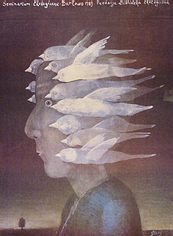
As much as I like this picture by Nicoletta Ceccoli, which adorns the cover of the last Born Magazine, it seems like...well, I'll say it - plagiarism. The Lithuanian-Polish artist Stasys Eidrigevicius painted incredibly similar pictures some 30 years ago or more, in a children's book I have somewhere in Poland. Here is an example of a similar book, though slightly different.
The pictures I'm refering to show a boy with his head covered in birds that fly away out of it. The book is a poem by Joanna Papuzinska about a boy that instead of having toys or adventures has ideas.
Even the birds look similar.
Then again, Bach's copy of Vivaldi's violin concerto was apparently a great tribute. How are we to judge?

Monika Hoinkis: humanizing the object

Why is the metronome only listening to its own rhythm? Can't it ever listen to me? React to me?
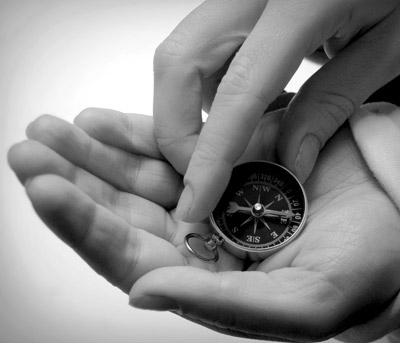
And this compass? Why should it always point to the North, ignoring me completely?
What if it actually lived with me? Monika Hoinkis decided to live with the objects and see if they will also accept to live with her. And they did.

The compass points at the person holding it. The metronome reacts to physical presence. Even water vibrates to... you guessed it, to your own heartbeat.
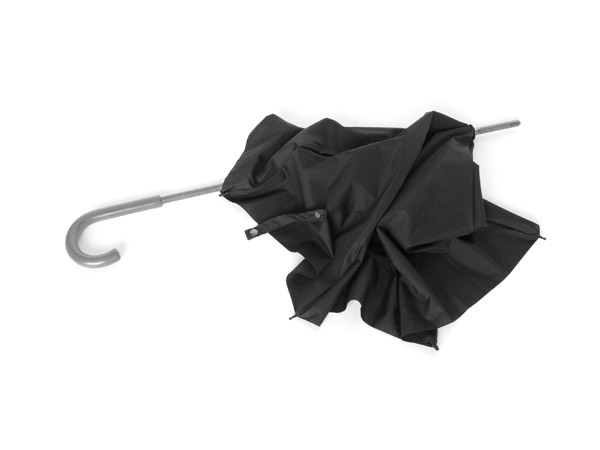
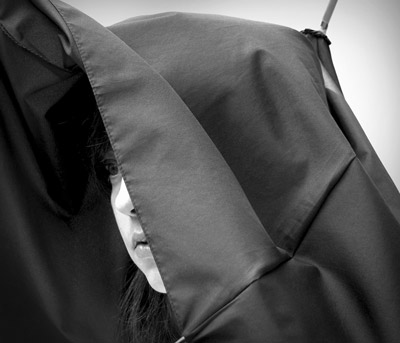
And this umbrella? Come on, you know you want it. Give it a hug. It's the only way to be well protected anyway.

See the whole Living with Things series.

Thursday, March 2, 2006

Women by women

Billboard (2003) by Heta Kuchka

Billboard (2003) by Liv Carlé
Part of the Billboard project www.women2003 :
From 23. March to 4. April [2003] one hundred and two Scandinavian female artists will present their own personal and artistic female image in the public space ? entering a dialogue with the images created by commercials. (...)
In that way the new female images created by this project will form a solid and diverse contrast to the monotonous representations created by the commercial market.
What is strange is how many of these works (the ones above included) define the woman through her relation to the man.
Both these images are disturbing. And they say somewhat similar things - the fear of rejection, the question of being appealing or not, the scary idea that the author, a woman, is completely wrong, just because she is herself.
And while it's supposed to question our values as men (and women who accept this), I'm not sure if it doesn't do exactly the opposite, provoking us to answer, "Get a grip on yourself girl! If you can't make him appreciate you for who you are, if you can't gain respect, if you get a guy that sees you as a toy, you better look around. There are plenty more of us, you know".
But, look at it from another point of view. The two works I present are part of a series of actual billboards put in and around Copenhagen and Malmö. They are not as much a statement, as they are an answer. They laugh at the myth. At the plastic imagery we know all-too-well. And if that answer tells more about men than about women, it might be giving us a hint about the images it aims to reply to.